No one owns the Moon. Article II of the 1967 Outer Space Treaty says the Moon and other celestial bodies are "not subject to national appropriation by claim of sovereignty, by means of use or occupation, or by any other means." More than 115 countries are parties, including every country that has landed on the Moon.
The open questions are about resources and rules. At least four countries let companies keep resources they extract, 76 countries have signed the US-led Artemis Accords, and China and Russia lead a rival lunar base project.
The treaty everyone signed
The Outer Space Treaty was written during the space race, mainly to stop the superpowers from carving up the Moon the way earlier empires carved up continents, and to keep nuclear weapons out of orbit. It opened for signature on 27 January 1967 in London, Moscow and Washington and came into force that October.
Three articles answer the ownership question:
- Article I: exploring and using space is "the province of all mankind," with free access to all areas of celestial bodies.
- Article II: no national appropriation of the Moon or other celestial bodies, by any means.
- Article VI: countries are responsible for national activities in space, including those of companies, which need government authorization and supervision.
Because property exists only where a government records and enforces it, Article II also closes the door on private land titles. Some sellers of lunar land argue that the treaty mentions nations and so leaves individuals free. We cover that argument, and the stronger reading against it, in the Outer Space Treaty explained.
What the Apollo flags mean
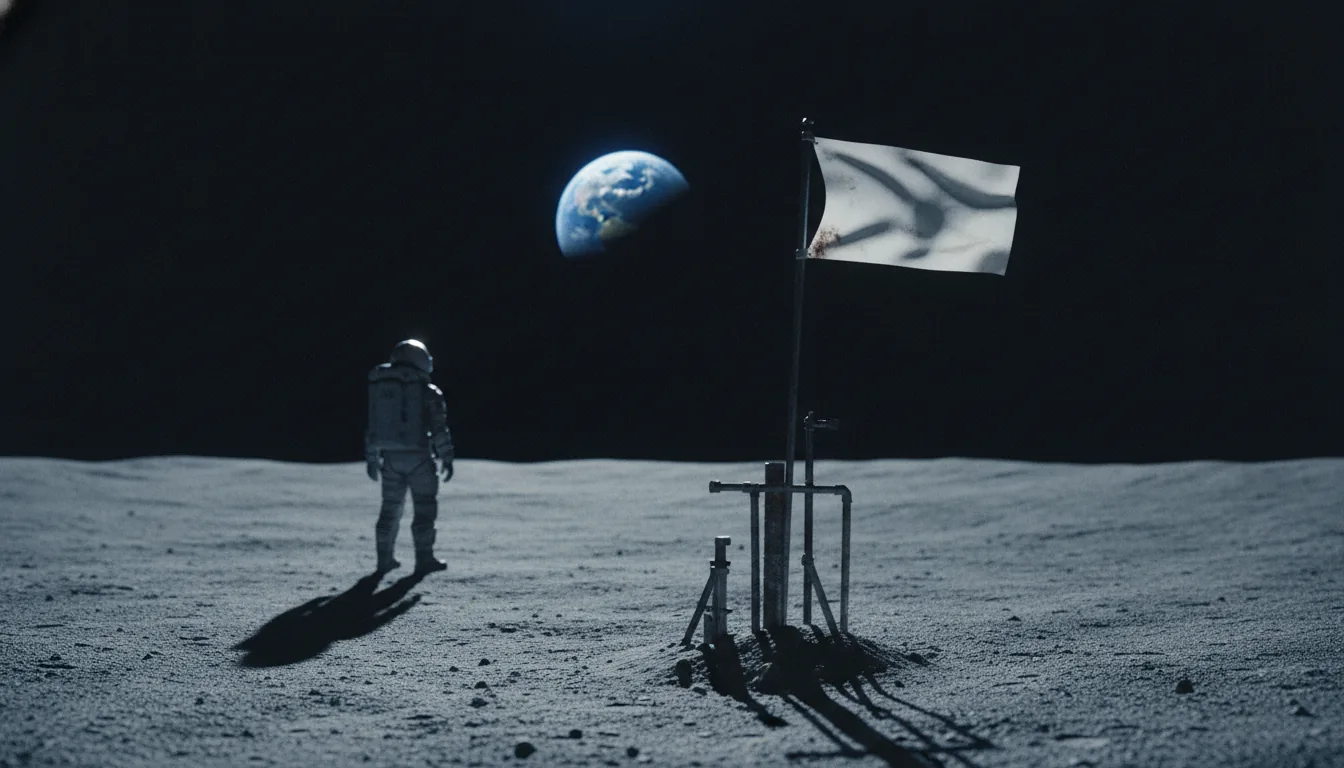
Six Apollo crews planted US flags between 1969 and 1972. Congress anticipated the question. The NASA authorization law of 18 November 1969 (Public Law 91-119) required the US flag on missions the US government paid for, and said the act "is intended as a symbolic gesture of national pride in achievement and is not to be construed as a declaration of national appropriation by claim of sovereignty." The plaque Apollo 11 left behind says the crew came "in peace for all mankind."
China displayed its flag on the near side with Chang'e-5 in 2020 and on the far side with Chang'e-6 in 2024. Those flags claim nothing either.
The treaty that tried to go further
In 1979 the UN adopted the Moon Agreement, which calls the Moon and its natural resources "the common heritage of mankind" and calls for an international regime to govern their use. It came into force in 1984 but never drew the spacefaring powers. Fewer than 20 countries have joined, and none of them is the United States, Russia or China. Saudi Arabia withdrew in January 2024, the first country ever to leave one of the five UN space treaties. In practice, the Moon Agreement does not shape what anyone does on the Moon.
Who can own what comes out of the ground
Land and resources have split apart in national law. Since 2015, several countries have said their companies may keep what they extract while disclaiming any claim to the ground:
- United States, 2015. The Commercial Space Launch Competitiveness Act lets US citizens "possess, own, transport, use, and sell" space resources they obtain (51 U.S.C. § 51303). Section 403 of the same act says the United States does not thereby assert sovereignty, exclusive rights, jurisdiction or ownership over any celestial body.
- Luxembourg, 2017. The first European law on space resources.
- United Arab Emirates, 2019 and Japan, 2021, with their own space resource laws.
The comparison people use is fishing on the high seas: nobody owns the ocean, but you keep the fish you catch.
The Artemis Accords and the rival bloc
The Artemis Accords are a set of non-binding principles for civil space exploration, launched by the United States and seven other countries on 13 October 2020. They had 76 signatories by late September 2026, after Albania, Croatia, Côte d'Ivoire and San Marino joined that month. Two provisions matter here: Section 10 says extracting resources does not in itself amount to national appropriation under Article II, and Section 11 introduces "safety zones" around operations so missions don't interfere with each other.
China and Russia have not signed. They lead the International Lunar Research Station project, which aims for a basic station near the lunar south pole by 2035. So the Moon now has two clubs writing practical rules, both inside the same 1967 treaty.
Private claims, from 1980 to today
The best-known private claim is Dennis Hope's. He says he filed a claim to the Moon in San Francisco in 1980 and wrote to the United Nations about it. His Lunar Embassy has sold lunar acres since. Other sellers followed, and today you can buy a lunar certificate for about $15 to $60. No government or court has recognized any of these claims as property. Our guide to buying land on the Moon compares what the sellers send.
Red Homestead takes a different approach. We start from the fact that nobody owns the Moon today and keep a registry of documented claims: a surveyed parcel, a 24-month public notice, priority by filing date, and a 19-document claim file. It conveys no title. It is a dated, public record of a person's claim, built on the way frontier claims were handled before any land office existed. See what the file contains.
Who will decide?
For now, the Moon is governed by the 1967 treaty, national resource laws, the Accords and whatever the people operating there agree to. If people settle the Moon for years at a time, some body will have to decide who may use which ground. NASA plans its next crewed landing no earlier than 2028, China says it will land astronauts before 2030, and SpaceX said in February 2026 that it is focusing on building a city on the Moon. Our guide to when people will live on the Moon follows those plans.
Keep reading
Sources
- UN Office for Outer Space Affairs: the Outer Space Treaty
- Public Law 91-119 (18 November 1969), the NASA authorization act with the flag provision
- UN Office for Outer Space Affairs: the Moon Agreement
- 51 U.S.C. § 51303
- NASA: the Artemis Accords and US State Department: Artemis Accords
- Government of China: plans for the International Lunar Research Station
- Lunar Embassy FAQ