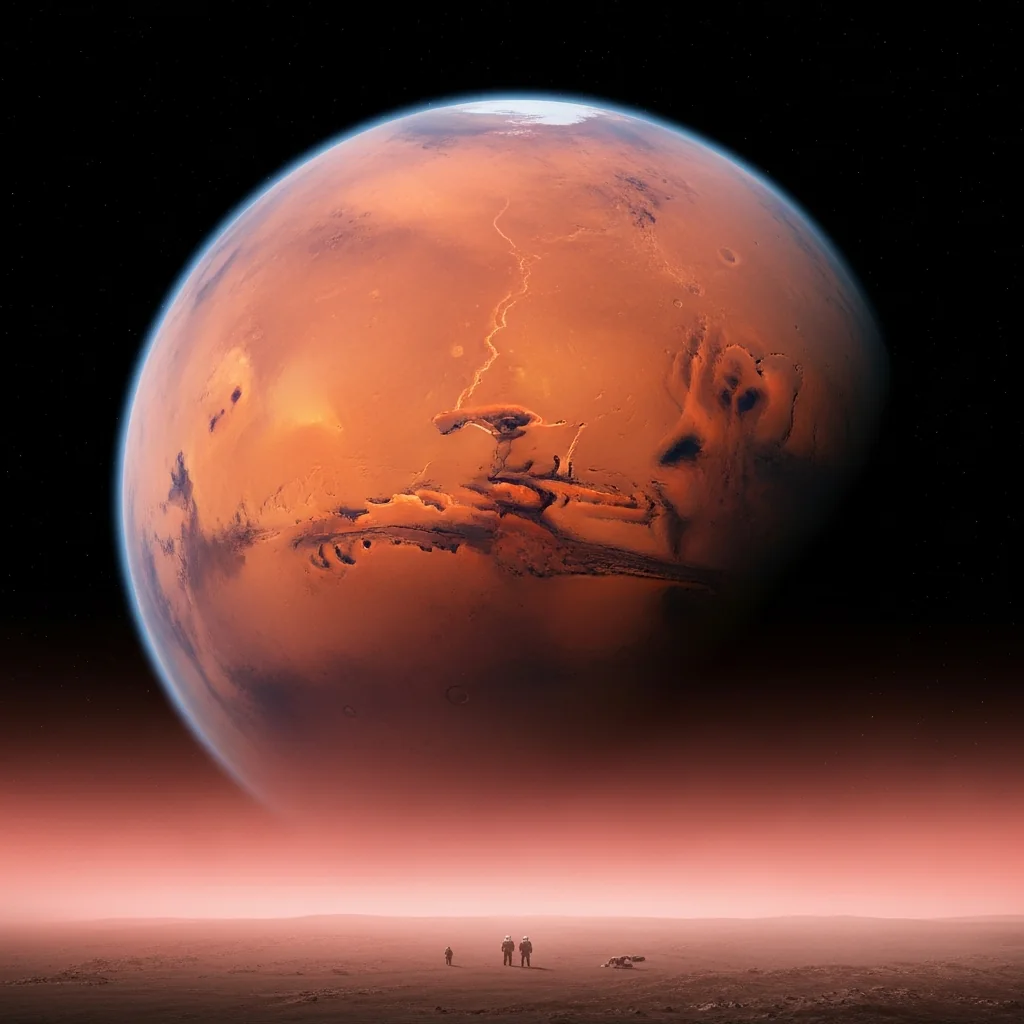
For someone who wants to look up: a small telescope, because Mars reaches opposition on 19 February 2027. For a reader: A City on Mars. For no budget at all: a free NASA JPL travel poster, printed. For a story they can keep: a claim to a surveyed lot on Mars.
1. A small telescope, timed for Mars
Mars reaches opposition on 19 February 2027. That night it is opposite the Sun, up from dusk to dawn and at its brightest for the season, eight weeks after Christmas. This is a far opposition, so Mars will look small: a beginner's telescope shows an orange disk, and on steady nights a larger one can pick out a polar cap and dark markings. The Moon, Jupiter's four big moons and Saturn's rings are easier and just as satisfying. For a first telescope, a steady mount matters more than magnification; skip any box that advertises a huge power number.
2. Binoculars for the Moon
A decent pair of 7x50 or 10x50 binoculars shows craters along the line between light and shadow, the dark lunar seas, and star clusters. They need no setup, so they get used on any clear night.
3. A claim to a lot on Mars
Our own product, so judge it accordingly. A Red Homestead gift is $39: you get a printable gift certificate with a code by email the moment you pay, and they redeem it to choose a 40-acre lot in Founding Tract One on Mars. The registry then issues a 19-document claim file and a certificate in their name, with a dated entry on the public registry roll and 12 months of monthly continuity reports. It is not title to land; nobody can sell that. It is a record of their claim and a good story. Pair it with the telescope and Mars at opposition in February. How the gift works.
4. Books
- A City on Mars by Kelly and Zach Weinersmith (2023): a funny, well-researched look at whether people can and should settle space, including who would own what.
- The Martian by Andy Weir: the survival novel that made orbital mechanics a page-turner.
- Packing for Mars by Mary Roach (2010): the strange practical science of living in space.
- Red Mars by Kim Stanley Robinson (1992): the classic novel of settling and terraforming Mars.
5. NASA JPL travel posters, free
NASA's Jet Propulsion Laboratory publishes "Visions of the Future," a set of retro travel posters for Mars, Enceladus, Europa and other destinations, free to download at full resolution. Print one at a local print shop and frame it. It is one of the best-looking gifts on this list for the price of the printing.
6. A Planetary Society membership
The Planetary Society, co-founded by Carl Sagan in 1980, is a nonprofit that advocates for planetary science and runs its own projects. Membership comes with its magazine, and it suits someone who wants to support exploration.
7. A piece of the Moon or Mars
A small share of the meteorites found on Earth were blasted off the Moon or Mars by ancient impacts, and fragments of them are sold legally by meteorite dealers. They are rare, so they cost far more than ordinary meteorites; a common iron or stony meteorite is a cheaper start. Buy from a dealer who documents each piece. Many reputable dealers belong to the International Meteorite Collectors Association.
8. A trip to see the real hardware
- Kennedy Space Center Visitor Complex in Florida has a Saturn V and the Space Shuttle Atlantis, and sells launch-viewing tickets for some launches.
- Space Center Houston, next to NASA's Johnson Space Center, runs tram tours to the old Apollo mission control.
- The Smithsonian's National Air and Space Museum in Washington, DC, holds the Apollo 11 command module Columbia, and admission is free.
9. A LEGO space set
LEGO makes NASA-licensed sets, from Apollo-era landers to the Artemis rocket. They are a good fit for adults who like to build as much as for kids. Check which sets are current, as LEGO retires them every few years.
10. Their name on a spacecraft
NASA runs free "Send Your Name" campaigns for some missions; Perseverance carried 10,932,295 names to Mars on three silicon chips. When a campaign is open, you get a printable boarding pass. It costs nothing and is a lovely stocking stuffer.
What to skip
Anything that promises the person will own a star, a crater or an acre that will be worth money later. The International Astronomical Union does not sell star names, and no one can sell title to land on the Moon or Mars. If you buy a certificate gift, buy it for what it is. Our guides on naming a star and buying land on the Moon explain why.