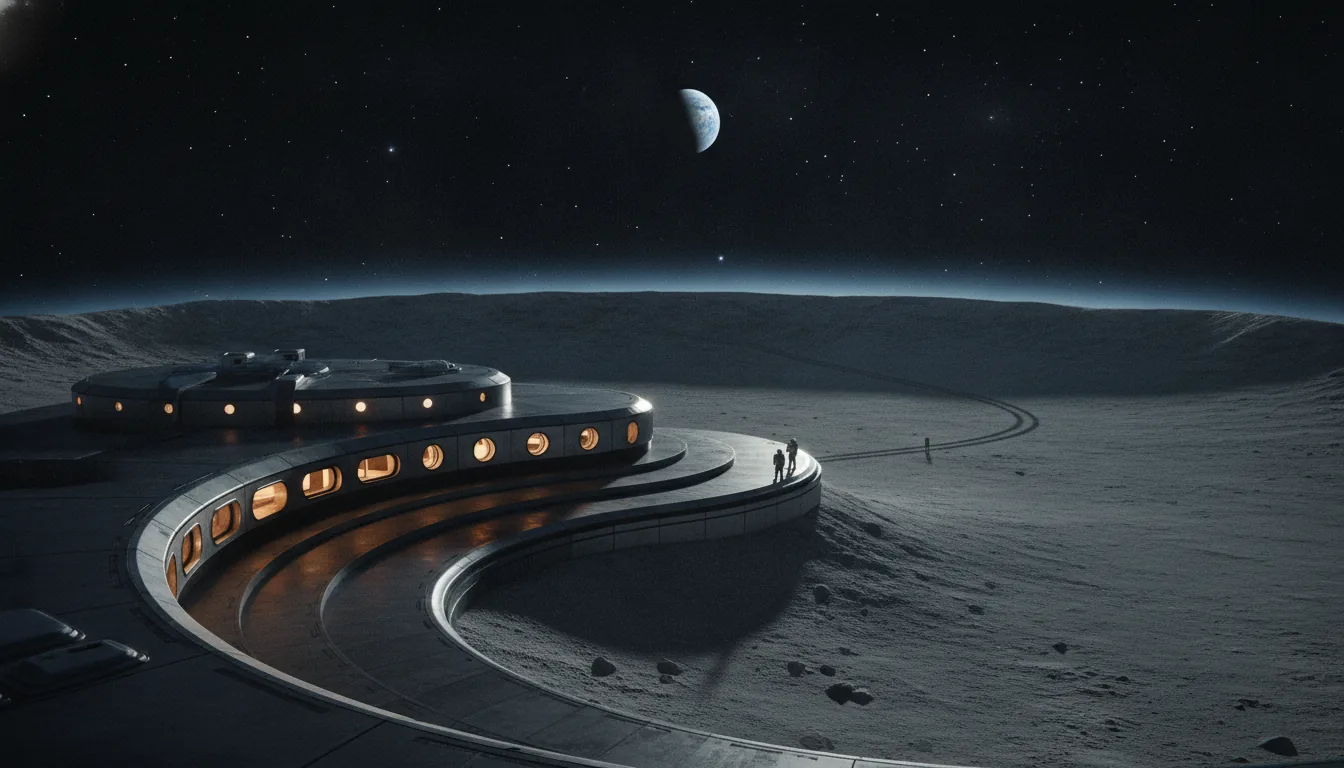
Astronauts are planned to walk on the Moon again no earlier than 2028 (NASA's Artemis IV) and before 2030 (China). Living there for months needs power through the two-week lunar night, so the first real bases are 2030s projects: NASA wants a reactor on the Moon by about 2030, and China and Russia plan a basic research station by 2035.
SpaceX said in February 2026 that it now puts a self-growing city on the Moon ahead of Mars, because the Moon is faster. It has not published a date.
NASA's Artemis program
Artemis II flew Reid Wiseman, Victor Glover, Christina Koch and Canada's Jeremy Hansen around the Moon from 1 to 11 April 2026, the first people beyond low Earth orbit since Apollo 17 in 1972. In February 2026 NASA reshaped the next missions. Artemis III, planned for mid-2027, will test docking with the landers and the new lunar spacesuits in Earth orbit. The first landing moves to Artemis IV, no earlier than 2028, and NASA has said it will try a second landing, Artemis V, the same year.
Two companies are building the landers: SpaceX with a lunar version of Starship, and Blue Origin with Blue Moon. Starship reached orbit for the first time on 28 September 2026. To land on the Moon it has to be refueled in orbit by a series of tanker flights, something no one has done yet. SpaceX has targeted an uncrewed lunar landing in 2027. Blue Origin's first uncrewed Blue Moon lander finished vacuum-chamber testing at NASA in 2026, and its mission is now planned for early 2027.
China's plan
China says it will land astronauts on the Moon before 2030. Its hardware is a crew ship called Mengzhou, a two-person lander called Lanyue, and the Long March 10 rocket. Lanyue completed an integrated landing and takeoff test in Hebei province on 6 August 2025. China's robotic program is also aimed at the south pole: Chang'e-7, a lander, rover and hopper built to look for water ice, had been due to launch in August 2026 and was pushed to 2027 after a typhoon hit the launch site area.
The longer plan is the International Lunar Research Station, led by China with Russia and other partners: a basic station near the south pole by 2035 and an expanded one in the 2040s.
SpaceX's Moon city
In early February 2026 Elon Musk wrote that SpaceX had "shifted focus to building a self-growing city on the moon," because it could potentially be done in less than ten years while Mars would take more than twenty. He also pointed out that ships can leave for the Moon every ten days, against once every 26 months for Mars. A year earlier he had called the Moon a distraction. The statement came with no published architecture or date, and the company's near-term lunar work is the NASA lander contract. It does explain why Starship's next milestones, orbital refueling and a lunar landing, matter to anyone following the idea of people living off Earth.
Why the south pole
Every serious plan points to the same place. Near the lunar south pole, the floors of some craters, such as Shackleton and Haworth, never see sunlight and stay cold enough to hold water ice. A few kilometers away, some ridges and crater rims are lit most of the time. That pairing is rare: ice for water, breathable oxygen and rocket fuel, next to almost constant sunlight for solar power. NASA's Artemis landing regions and China's Chang'e-7 target are all there.
What living there takes
- Power through the night. Most of the Moon gets about two weeks of darkness at a time. In August 2025 NASA set a goal of a reactor producing at least 100 kilowatts on the Moon by about 2030, and in January 2026 NASA and the Department of Energy signed an agreement to build it.
- Water from ice. Mining and melting polar ice is the plan for drinking water, oxygen and propellant. Nobody has done it yet; Chang'e-7 and other landers are meant to measure how much ice is there and how it is mixed with soil.
- Shielding. The Moon has no magnetic field and no air to block radiation, so long stays mean living under a few meters of lunar soil or inside heavy shielding.
- Dust. Lunar dust is sharp and clings to everything. Apollo crews found it worked into suits and seals, and some reported hay-fever-like symptoms after breathing it in the cabin.
Much of this mirrors what a Mars settlement needs. Our long-read on living off Mars covers the same problems, power, water, shielding and metal, on the Red Planet.
Whose rules will apply
No country may claim the Moon under the 1967 Outer Space Treaty. Practical rules are being written by two groups: the 76 countries that have signed the US-led Artemis Accords, which allow "safety zones" around operations, and the partners of China's research station. Neither group can grant land. Our guide to who owns the Moon covers the law.
The timeline as of October 2026
| Milestone | Plan |
|---|---|
| Crew flies around the Moon | Done: Artemis II, April 2026 |
| Artemis III lander and suit tests in Earth orbit | Mid-2027 |
| Uncrewed Starship and Blue Moon landings | Targeted for 2027 |
| First Artemis crew landing | Artemis IV, no earlier than 2028 |
| First Chinese crew landing | Before 2030 |
| NASA reactor on the Moon | Goal of about 2030 |
| International Lunar Research Station, basic model | 2035 |
| SpaceX Moon city | No published date |
A claim on the Moon today
Nobody can sell lunar land, and Red Homestead doesn't. What we keep is a registry of documented claims: you pick a parcel on NASA's Lunar Reconnaissance Orbiter map in the claim explorer, and it gets coordinates on the Moon's official reference frame, a 24-month public notice and a 19-document claim file. The explorer's "Shackleton (Moon)" button jumps to the south pole. A claim is $39. Read can you buy land on the Moon for exactly what that does and doesn't mean.
Keep reading
Sources
- NASA: Artemis II
- Scientific American: NASA moves the first Artemis landing to 2028
- NBC News: SpaceX prioritizes a city on the Moon (February 2026) and Phys.org: SpaceX shifts focus from Mars to the Moon
- NASA: Blue Origin lander completes vacuum-chamber testing
- SpaceNews: China completes landing and takeoff test for its crewed lander
- SpacePolicyOnline: Chang'e-7 launch
- Government of China: International Lunar Research Station plans
- NASA: Fission Surface Power