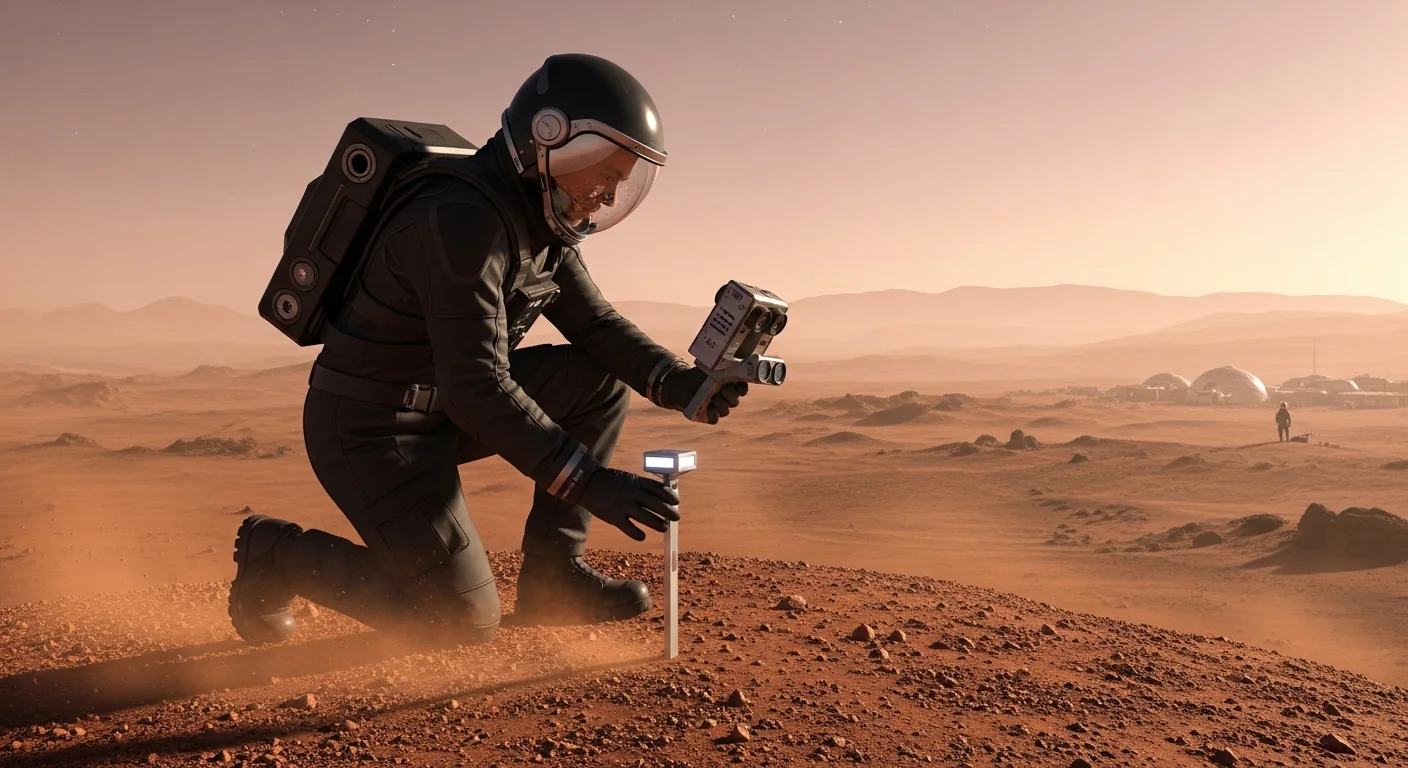
No one can sell you title to land on Mars. The 1967 Outer Space Treaty covers "the Moon and other celestial bodies," and Mars is one of them: no country may claim it, so no land office or court can record or enforce a private title there.
What is for sale is paper. Certificate sellers charge about $35 to $60 an acre or plot. Red Homestead charges $39 for a documented claim to a surveyed parcel, published on a public registry. It is a forward claim and a collectible, not property.
Why no one can sell Mars land
The treaty's Article II says outer space, "including the Moon and other celestial bodies," is not subject to national appropriation "by any other means." Article VI makes every country responsible for what its citizens and companies do in space. Put together, they leave no government that could record or enforce a title to Martian ground. The full reasoning is in our Moon guide and our Outer Space Treaty explainer, because the law is the same for both.
Mars adds a practical fact: nobody has been there. Every spacecraft that has reached the surface has been a robot. NASA's Curiosity and Perseverance rovers are still driving, and China's Zhurong rover went quiet in 2022. No crewed mission has a launch date.
Who sells Mars land, and what you get
- Lunar Embassy lists acres on Mars at $34.99 each. Each order is three printed documents on 11 x 14 inch paper: a "Martian deed," a map and a set of "codes, covenants and restrictions." A PDF version costs $10 more. The company says it filed its claim and notified the United Nations in 1980.
- Buy Planets sells 100-acre plots on Mars, the Moon or Venus at $59.90, each with a coordinate certificate and an overview map. It cites the treaty's wording about governments as its legal basis.
- Red Homestead sells a $39 claim to a surveyed parcel of 160, 640 or 2,560 acres, with a 19-document claim file, a 24-month public notice and an entry on the public registry roll.
Prices are as listed on 4 October 2026. For a seller-by-seller table, see moon and Mars land sellers compared.
What NASA offers instead
People often search for "buy land on Mars NASA." NASA does not sell land. It has run free "Send Your Name to Mars" campaigns: the Perseverance rover, which landed in Jezero Crater in February 2021, carries three silicon chips with 10,932,295 names, and Curiosity carried about 1.2 million. Those campaigns open for particular missions, so watch NASA's site for the next one. They are a lovely free gift on their own.
Where on Mars a claim makes sense
If you are choosing ground, choose it the way a settler would. Our research paper, where the first Martians will live, scores twelve regions on water ice, landing safety, elevation, radiation, power and dust. The best ground falls in a band between about 35 and 48 degrees north.
- Arcadia Planitia: flat, with ice a meter or two down. The most-cited candidate for a first settlement.
- Deuteronilus Mensae: buried glaciers under mesas.
- Jezero Crater: the ancient lake where Perseverance works. Its active zone is reserved, so claims sit outside it.
- Olympus Mons and Valles Marineris: the views, with harder ground.
Red Homestead's own subdivision, Founding Tract One, sits in Acidalia Planitia around 41° north and 337° east, laid out as 40-acre lots with roads, parks and commons. It is the default place to stake a lot.
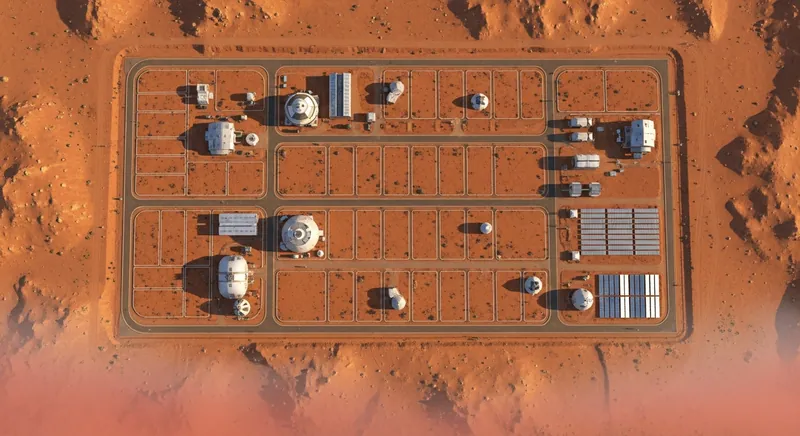
What a Red Homestead Mars claim includes
- A surveyed parcel. Corner coordinates on the IAU areographic frame, a Parcel ID and a latitude-corrected acreage.
- Reserved ground left alone. The explorer blocks claims over 20 reserved zones: 13 lander and rover sites, three human exploration zones NASA has studied, and four SpaceX candidate landing regions.
- One claimant per parcel, a 24-month public notice, and priority by filing date if anyone contests.
- The claim file. 19 documents by email, a certificate to frame, and 12 months of the monthly continuity report. A printed file in an envelope is $50 more.
It does not include title, a right to land there, or any promise that a future authority will recognize the claim. If people do settle Mars and some authority begins recording private claims, a dated, public, well-documented claim is the strongest record a person can hold today. That is the whole idea. How it works has the details.
When could anyone go?
Not soon. In February 2026 SpaceX said it had shifted its near-term focus to the Moon and expected to start building toward a Mars city in five to seven years. Its Starship reached orbit for the first time on 28 September 2026. The current low-energy window to Mars opens in November 2026, and no crewed or Starship flight is planned for it; the next windows come around the turn of 2028 to 2029 and in 2031. Our timeline, when will humans go to Mars, tracks each milestone.