Founding registrations open July 1, 2026. Explore the registry and survey your parcel now — accounts and claims open July 1.
The Frontier Library · Deep dive
Free land, and the wildest road ever offered to reach it.
For a filing fee of about eighteen dollars and five years of your life, the United States would hand you 160 acres of a continent. Millions took the deal. This is the true story of how they packed their entire world into a single wagon, what the 2,000-mile road actually cost them, and why the oldest idea on the frontier is about to matter again.
By the Red Homestead Registry~16,000 words · about an hourJuly 2026
🌾
This is real American history, told straight — the adventure and the hard parts both. It is the story behind our name. Red Homestead conveys no legal title on the Moon or Mars; this article explains where the homestead idea comes from, not a promise about the frontier ahead.
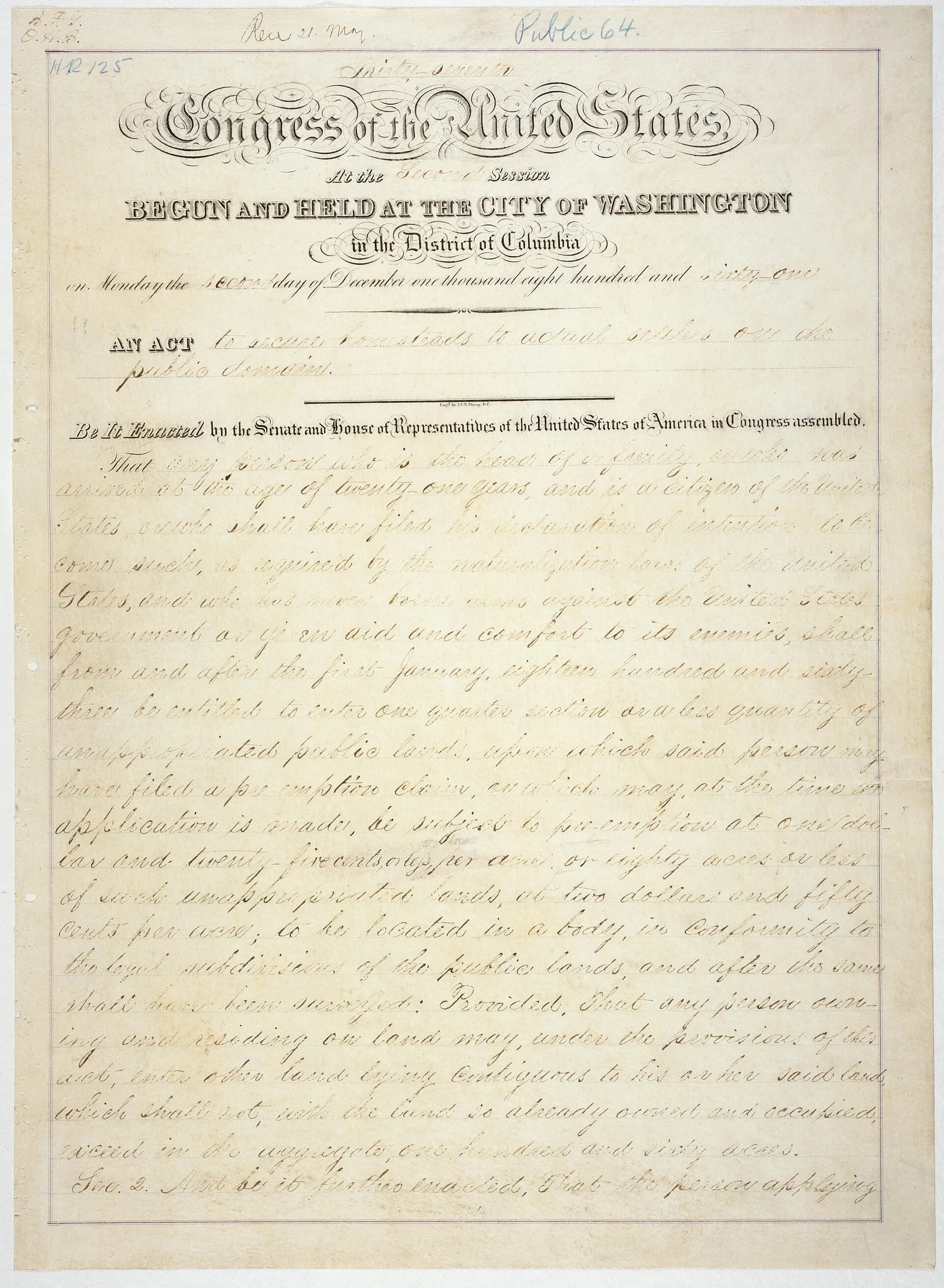
In 1862, in the middle of a war that was tearing the country in half, Abraham Lincoln signed a law that would give away an area larger than Texas and California combined — for free — to anyone brave or desperate enough to go and live on it. Not sell it cheaply. Give it away. All you had to do was get there, build a house, farm the ground for five years, and prove you'd done it.
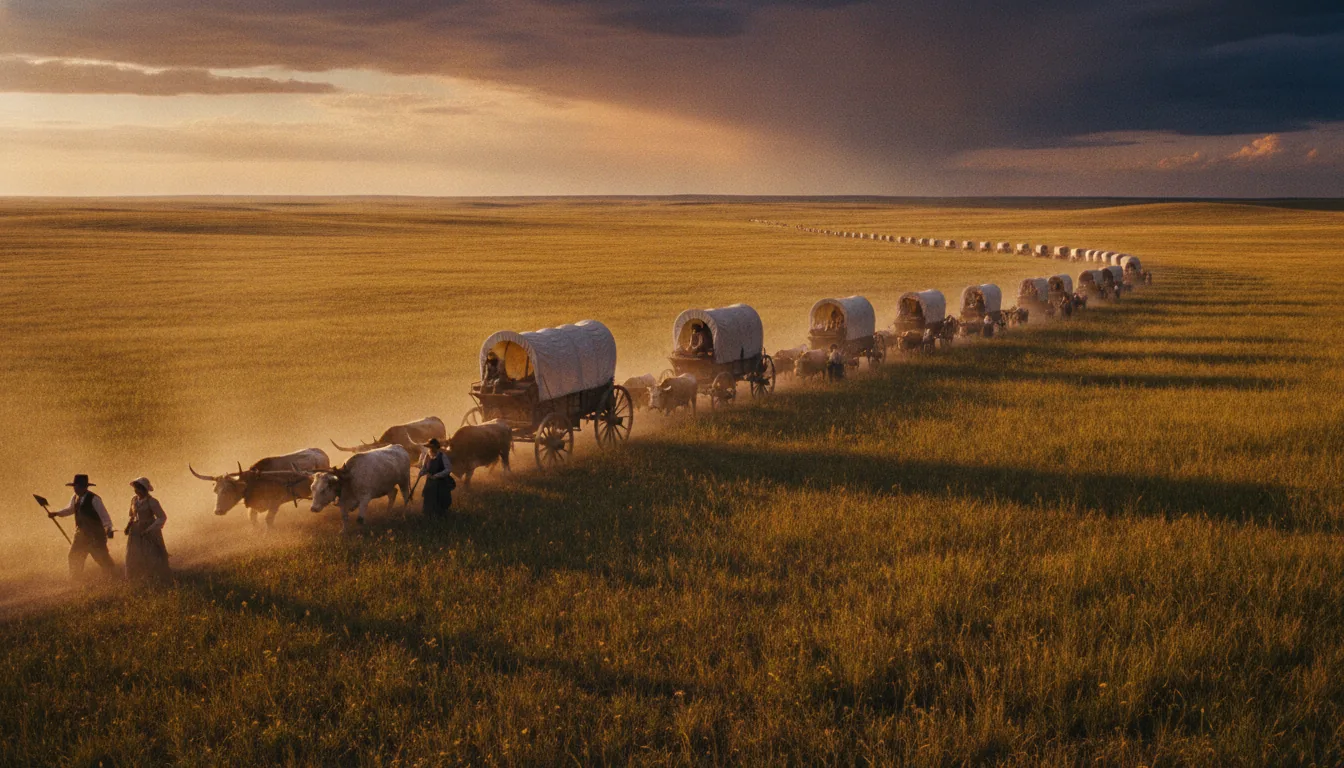
"Getting there" is where the story really lives. Between the settled East and that free quarter-section lay up to two thousand miles of prairie, river, desert and mountain, crossed at the walking pace of an ox — about fifteen miles a good day, four to six months if nothing went wrong, and something almost always went wrong. Families sold everything they owned, compressed what remained into a wagon the size of a small bedroom, and pointed it at the sunset.
It is easy, at this distance, to flatten them into a sepia postcard — a tidy wagon, a noble ox, a good sunset. They were not a postcard. They were specific, frightened, hopeful, stubborn people making the largest bet of their lives on the worst odds most of them would ever face, and a great many of them lost. What follows tries to give them back their specificity: the real price of the outfit, the real weight in the wagon, the real graves along the road, and the real range of who climbed aboard. If parts of it read like an adventure, that's because it was one. If parts of it read like a warning, that's because it was that too.
This is the history of that gamble: the law that started it, the wagon that carried it, the road that tested it, and the astonishing range of people — a Union scout at one minute past midnight, a future scientist in a Kansas sod house, formerly enslaved families building a town from nothing, thousands of women filing claims in their own names — who bet their lives on 160 acres they had never seen. We'll count what it truly cost, look inside the wagon bolt by bolt, walk the trail landmark by landmark, and tell the hard parts honestly, because the best version of this story is also the truest one.
And at the very end, we'll do the one thing a registry named Red Homestead is obliged to do: ask what all of it means now that the last earthly frontier has closed and a new one — silent, airless, and entirely unclaimed — has opened overhead.
160free acres$18filing fee5 yearsto prove up2,000 milesof trail~15 milesa good day4–6 monthson the road4 yokeof oxen2,000 lbsthe load limit1 in 10never arrived1.6 millionpatents270 millionacres given away160free acres$18filing fee5 yearsto prove up2,000 milesof trail~15 milesa good day4–6 monthson the road4 yokeof oxen2,000 lbsthe load limit1 in 10never arrived1.6 millionpatents270 millionacres given away
The offer
160 acres, and a signature in the middle of a war.
To understand how strange the Homestead Act was, start with when it happened. It was signed on May 20, 1862 — not in a season of peace and plenty, but thirteen months into the Civil War, with the country splitting apart and young men dying by the tens of thousands. In that of all moments, the United States decided to give away a large piece of itself.
It was not a coincidence. For forty years, Southern politicians had blocked every "free land" bill in Congress, terrified that a West full of small free farms would be a West with no room for slavery. When the Southern states seceded, their senators walked out — and the opposition walked out with them. Within a year, the bill they had strangled for a generation sailed through. The law took effect on January 1, 1863, the very same day as the Emancipation Proclamation. It was, in the most literal sense, a different country's idea.
It is worth sitting with that timing a moment longer, because it made the Act what it was. For decades the fight over "free land" had really been a proxy war over slavery: would the new western territories be worked by independent free farmers on small plots, or by enslaved labor on great plantations? As long as the South held its seats, the question stayed deadlocked. Secession broke the deadlock overnight. With the Southern bloc gone, a Republican Congress and a Republican president could finally enact the free-soil vision they had campaigned on — and they did it deliberately, as a statement of what kind of country the Union was fighting to become. The Homestead Act was, in that sense, a war aim. Lincoln signed it with one hand while, with the other, he waged the war that would decide whether the West it opened would be free.
The offer itself was almost reckless in its generosity: 160 acres — a quarter of a square-mile "section" of surveyed public land — handed to you, free, if you were willing to go and earn it. And the door was thrown remarkably wide. To file, you had to:
Be 21 years old, or the head of a household;
Be a citizen — or simply have filed papers declaring you intended to become one. That single clause let in millions of immigrants fresh off the boat.
Have never borne arms against the United States — the Civil War loyalty test, aimed squarely at Confederates.
Read who that included, because it is the quietly radical part. The 1862 law carried no racial language, and after the Civil Rights Act of 1866 and the Fourteenth Amendment, formerly enslaved people could file. So could immigrants. And crucially, so could women — single, widowed, divorced, or deserted women could claim 160 acres in their own name, at a time when a married woman in most states could barely own a teapot outright. More than a hundred thousand of them eventually did. For a huge number of Americans, this was the first shot at owning property that the country had ever offered them.
Why 160 acres, of all numbers? Because the country had already been sliced, on paper, into a giant grid. Since 1785 the government had surveyed its public domain into six-mile-square townships, each cut into thirty-six one-mile "sections" of 640 acres, each section quartered into 160-acre parcels. A quarter-section was the natural unit — thought big enough to feed a family on the well-watered prairie, small enough to hand out by the million. It is why so much of the American Midwest, seen from an airplane window today, is a perfect checkerboard of square farms and right-angled roads: you are looking down at the homestead grid, the shape the Act pressed onto half a continent. The 160-acre quarter-section became the basic tile of American settlement, stamped out over and over until it ran out of country.
The document that moved a continent. Page one of the Homestead Act of 1862. Its promise was simple enough to fit on a handbill: live on the land, work it for five years, and it is yours. U.S. National Archives · public domain.
The catch inside the gift
"Free," of course, came with a to-do list — and the list is the whole point, because it defined what the country decided a real claim looked like. To turn your filing into a patent (the actual title), you had to "prove up": live on the claim continuously for five years, build a house, farm the ground, and then show up at the land office with two neighbors willing to swear under oath that you had genuinely done it.
You have probably heard that the house had to be "twelve by fourteen." It is one of the trail's favorite legends — and the law never said any such thing. The statute set no minimum dimensions at all; the famous 12×14 came from local land-office custom, and the frontier joke was that a sharp operator would build a doll-sized "twelve-by-fourteen" cabin and, when the clerk squinted, insist the measurement was in inches. Treat the 12×14 as folklore, not law.
The residence requirement, though, had real teeth. You could not file a claim and farm it from town; the law wanted a genuine settler physically living on the ground, and land agents and rival claimants alike watched for the absentee who filed and vanished. A claim left empty could be "contested" by the next comer who could prove you weren't really there — so the five years were meant to be lived, through the droughts and the winters and the loneliness, in a house on the actual dirt. That, far more than the filing fee, is what made a homestead expensive. The government's real price was never measured in dollars. It was measured in years of your life, spent in one place, at hard labor, with no guarantee at the end.
For the impatient, there was a back door called commutation: after just six months of residence and improvement, you could skip the five-year wait and simply buy the quarter-section outright at $1.25 an acre — $200 for the whole 160. And the up-front fees to file? Famously cheap. The standard figure is about $18 all in — roughly $10 to file, a $2 agent's commission, and a final proof fee of about $6 when you came back to claim your patent. Eighteen dollars for 160 acres of America.
The law that kept growing
The 1862 Act was only the opening bid. Over the next half-century Congress kept rewriting the bargain to fit country the original law had never imagined — drier, emptier, and far harder to farm — and the story of those amendments is really the story of the frontier running out of easy land.
First came an attempt at justice that mostly failed. The Southern Homestead Act of 1866 opened some 46 million acres across five former Confederate states and gave freedmen and loyal whites first claim to it — on paper, a chance to turn freedom into land. In practice the available ground was mostly poor pine barren and swamp, officials dragged their feet, and violence and discrimination did the rest. Freedmen filed only about 6,500 claims and completed a fraction of them; Congress repealed the act in 1876 and handed the rest to timber companies. It stands as a hard reminder that a homestead was only ever as good as the ground — and the fairness — behind it.
Then came the adjustments for a thirstier West. The Timber Culture Act of 1873 offered another 160 acres to anyone who would plant and keep trees on the bare plains. The Desert Land Act of 1877 let a settler claim up to 640 acres of true desert on a promise to irrigate it within three years. And as the good quarter-sections ran out, the government simply made the claims bigger to match the poorer land: the Kinkaid Act of 1904 allowed full 640-acre homesteads in the Nebraska Sandhills, the Enlarged Homestead Act of 1909 granted 320 acres of dry-farming country, and the Stock-Raising Homestead Act of 1916 gave 640 acres of grazing land while the government kept the minerals underneath. Each new law told the same quiet truth: the free land that remained was worth less and less, and it took more and more of it to feed a family.
1862Homestead Act
160 acres, free. Live on it five years, improve it, prove it up. The founding bargain.
1866Southern H.A.
Land for the freed. 46 million acres opened to freedmen first — but on poor ground, and it largely failed. Repealed 1876.
1873Timber Culture
Plant trees, get 160 more. A scheme to forest the plains — and one widely gamed.
1877Desert Land
640 arid acres for a promise to bring water onto them within three years.
1904Kinkaid Act
640-acre homesteads in the Nebraska Sandhills — bigger claims for poorer land.
1909Enlarged H.A.
320 acres for dry-farming the semi-arid West.
1916Stock-Raising
640 grazing acres — the surface only; the government kept the minerals.
270M
acres eventually deeded to homesteaders — about 10% of the entire United States
1.6M
claims that made it all the way to a final patent
30
states that held homestead land, from Florida to Alaska
~4 in 10
the share of claims that actually succeeded — most who started, failed
That last number is the one to hold onto. The rhetoric said "free land for anyone." The reality was that the eighteen-dollar fee was the cheapest thing about the whole enterprise — and well over half of the people who filed a claim never proved it up. The distance between the promise and the patent was measured in something the poster never mentioned: about two thousand miles of trail, and everything it took to survive them. Which is where the real story starts.
The first claim
Daniel Freeman talks his way in at ten past midnight.
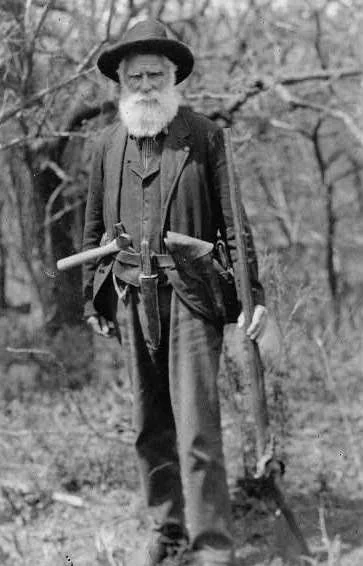
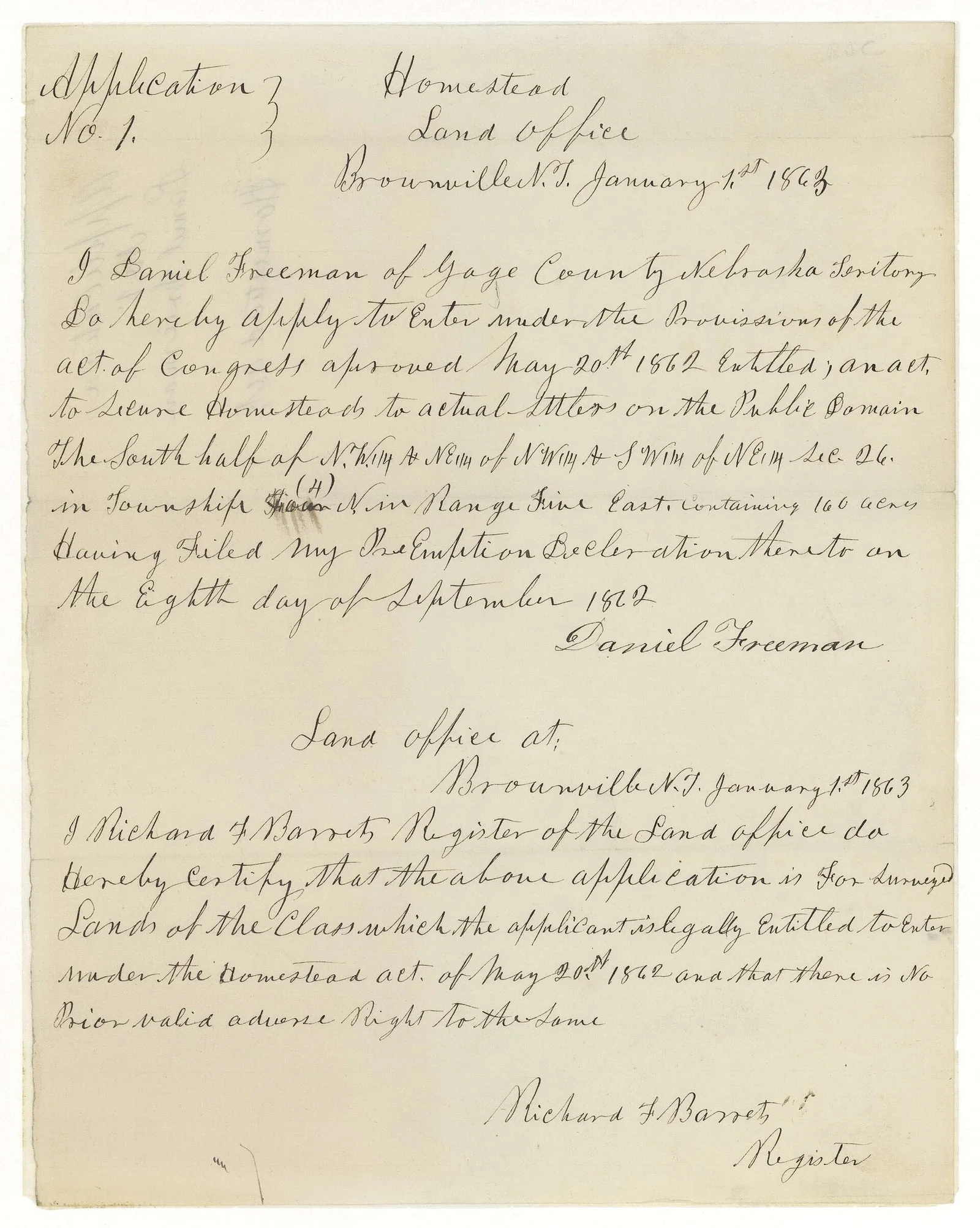
The law took effect on New Year's Day, 1863, and the story goes that the very first person through the door didn't even wait for the door to open. His name was Daniel Freeman — a Union Army scout, home on furlough in Nebraska, due to leave with his unit before dawn. As the tale is told, Freeman was at a New Year's Eve celebration in Brownville where the local land officer happened to be among the revelers, and he talked the clerk into opening the office just after the stroke of midnight so he could file before he had to ride off to the war. Roughly ten minutes past midnight on January 1, 1863, he entered a claim on Cub Creek, near Beatrice — and, as legend has it, walked away with homestead certificate No. 1.
Here honesty requires a small asterisk, because a registry named for homesteading ought to get its own founding myth right. Land offices across a dozen territories all opened that same morning, and a great many eager settlers filed in those first hours. Whether Freeman was provably the first person in the entire country is one of those cherished frontier "firsts" that is celebrated far more than it is documented. What is true is that his descendants and his hometown fought successfully to have him remembered as the first — and in 1936 Congress agreed, turning his farm into a national monument. Today it is Homestead National Historical Park. He is the first homesteader in the way that a country chooses its symbols: by deciding to.
What is not a myth is the hunger the Act unleashed. When the land offices opened that January morning, the pent-up demand of a generation came through the doors at once — clerks working by lamplight, lines forming in the cold — and by the end of that first year settlers had filed on hundreds of thousands of acres. Freeman's midnight sprint was only the most photogenic version of something happening at every land office on the frontier: ordinary people, many of them poor, many of them immigrants, racing to convert a slip of paper into a piece of a continent. The Act had promised land to anyone willing to earn it, and "anyone" turned out to mean an entire restless nation.
Daniel Freeman, 1904. LOC via NPS · public domain.Freeman's actual 1863 claim paper. NPS · public domain.
Strip away the midnight drama and what's left is better than the legend: a real family, and a real life on the ground. Freeman was a trained physician — he'd studied medicine in Cincinnati and practiced in Illinois before the war — and he built a working farm on that Cub Creek claim. The romance of it is genuine, too. His bride, Agnes Suiter, had originally been engaged to Daniel's brother James, who was killed in the war; Daniel then courted Agnes by mail and proposed to her in a letter. They married in February 1865, raised seven children to adulthood on the homestead, and Agnes lived out nearly her whole life on that same ground, dying there in 1931 — sixty-eight years after her husband's midnight filing.
And Daniel Freeman turned out to be exactly the kind of stubborn, independent character the homestead system seemed to breed. Decades later, he noticed that the teacher at the local Freeman School was reading the Bible, leading prayers, and singing hymns in the public classroom. He objected — and when the school wouldn't stop, he sued. In 1902 the Nebraska Supreme Court ruled in his favor in Freeman v. Scheve, a genuine landmark in the separation of church and state, decided in the name of a country doctor who had once talked his way into a land office after midnight. The first homesteader spent his life proving that a person who owns his own ground answers to no one. That is the spirit the rest of this story runs on.
Outfitting
What $600 bought you in 1849 — and why "free" land wasn't.
Before you could earn free land, you had to reach it, and reaching it was where the money went. The jumping-off point was almost always a raw, roaring town on the Missouri River — Independence, Westport, St. Joseph, Council Bluffs, or Nebraska City. These towns sat at the practical head of steamboat navigation: the last place a family could stand on a plank sidewalk and buy a wagon, a team of oxen, and a half-ton of flour before the map turned to open grass. St. Joseph became the busiest of them by the 1850s — a little farther up the river, and mercifully upstream of the cholera that kept breaking out at Independence.
In the outfitting season those towns were a spectacle unto themselves — a churning bottleneck where the settled world ended and the crossing began. For a few frantic weeks each spring the streets of Independence and St. Joseph filled with thousands of impatient emigrants, mountains of freight, bawling oxen and mules, blacksmiths hammering around the clock, and sharp-eyed merchants only too happy to sell a greenhorn twice the flour he needed and a wagon that wouldn't survive the Platte. Families camped on the outskirts for days or weeks, waiting for the grass to green and for the rest of their company to gather, haggling over animals, and repacking the wagon a dozen times as trail veterans walked the camps telling them what to throw out before they had even left. It was the last place to buy anything, the last post office, the last doctor, the last courtroom. Past the edge of town, a family was on its own for two thousand miles.
So why on earth did they go? Push as much as pull. The 1840s and 1850s were decades of economic churn — bank panics, crushing farm debt, worn-out soil in the East, and too many sons for too few acres. To a family staring at tenancy or worse, a mortgage-free 160 acres was not a romantic daydream but a hard-nosed calculation: the one place left where they could actually own something. Over that was layered the era's roaring gospel of Manifest Destiny — the widely-preached conviction that Americans were fated to fill the continent to the Pacific — and, after 1848, the electric news of gold in California. Land hunger, debt, faith, and gold all pulled in the same direction: west. The wonder is not that so many went. It's that they went knowing, from the graves and the guidebooks, roughly what it might cost them.
And notice what the outfit really was: not a purchase but a conversion. A family didn't buy a wagon the way you buy a car; they liquidated an entire life — sold the house, the extra stock, the furniture and tools they couldn't carry — and poured the proceeds into one wagon, one team, and a half-ton of flour. The prairie schooner rolling out of St. Joseph wasn't a vehicle. It was a family's complete net worth, on wheels, rolling toward a piece of ground it was trusting sight unseen. If the oxen died, if the wagon broke beyond repair, if the cholera took the breadwinner, there was no fund to fall back on — because the fund was the wagon. That total, all-in commitment is what made both the courage and the desperation of the trail so absolute. They had, quite literally, bet the farm.
An "outfit" was the whole kit you needed to survive the crossing, and thanks to the emigrant guidebooks of the day we know almost to the pound and the penny what one cost. Here is a real one: the "Oxen" outfit recommended for three people in 1849, straight out of a period guide.
A documented 1849 emigrant outfit — "No. 2, Oxen" — for three persons
Item
Detail
Cost (1849)
Four yoke of oxen
eight animals, the engine of the trip
$200.00
Wagon cover, bows & fittings
(the wagon body itself, ~$70–100, wasn't even on the list)
$100.00
Three rifles
$20 each
$60.00
Three pairs of pistols
$15 each
$45.00
Flour
1,080 lbs
$20.00
Bacon
600 lbs
$30.00
Coffee, sugar, rice, tea, dried fruit
~380 lbs together
$24.50
Powder, lead, tools, mining tools
~116 lbs
$26.20
Tent, bedding, cooking gear, lard, soap
~205 lbs
$39.30
One mule
the fast, ornery spare
$50.00
Salt, saleratus & sundries
$5.00
Total outfit
~2,583 lbs of cargo
$600.00
Add the wagon body the list forgot, and the all-in number lands around $670–$700. Across all the guidebooks and years, a family's outfit ran from a bare-bones $400 (if you already owned a wagon and animals) to $1,000 and up if you bought everything new and packed a full year's food to live on before the first harvest came in. Center of the range, in the gold-rush year of 1849–50: about $600. Then the Forty-Niners flooded the outfitting towns and the price of a yoke of oxen jumped by half.
"Free" land, in today's money
A dollar in the early 1860s is worth roughly thirty to thirty-three of today's (the exact figure swings with the Civil War's runaway wartime inflation, so treat it as a range). That turns the $18 filing fee into about $550 — genuinely cheap. But it turns a $600 outfit into roughly $18,000–$20,000, and a full $1,000 "wagon, team, and a year of food" into about $30,000–$33,000. The land was nearly free. Getting to it, and surviving long enough to prove up, cost a middle-class family its entire savings — and often everything it could borrow on top.
This is the honest heart of the "free land" story. The eighteen dollars was never the price. The price was selling the farm you had, converting your whole life into a wagon and a team, and betting all of it on a quarter-section you had never laid eyes on, two thousand miles away. People did it anyway — hundreds of thousands of them — because for a family with more children than prospects, a mortgage-free 160 acres at the end of a hard road still looked like the best deal in America. So they loaded the wagon. Which raises the question at the center of this whole story: what, exactly, do you take?
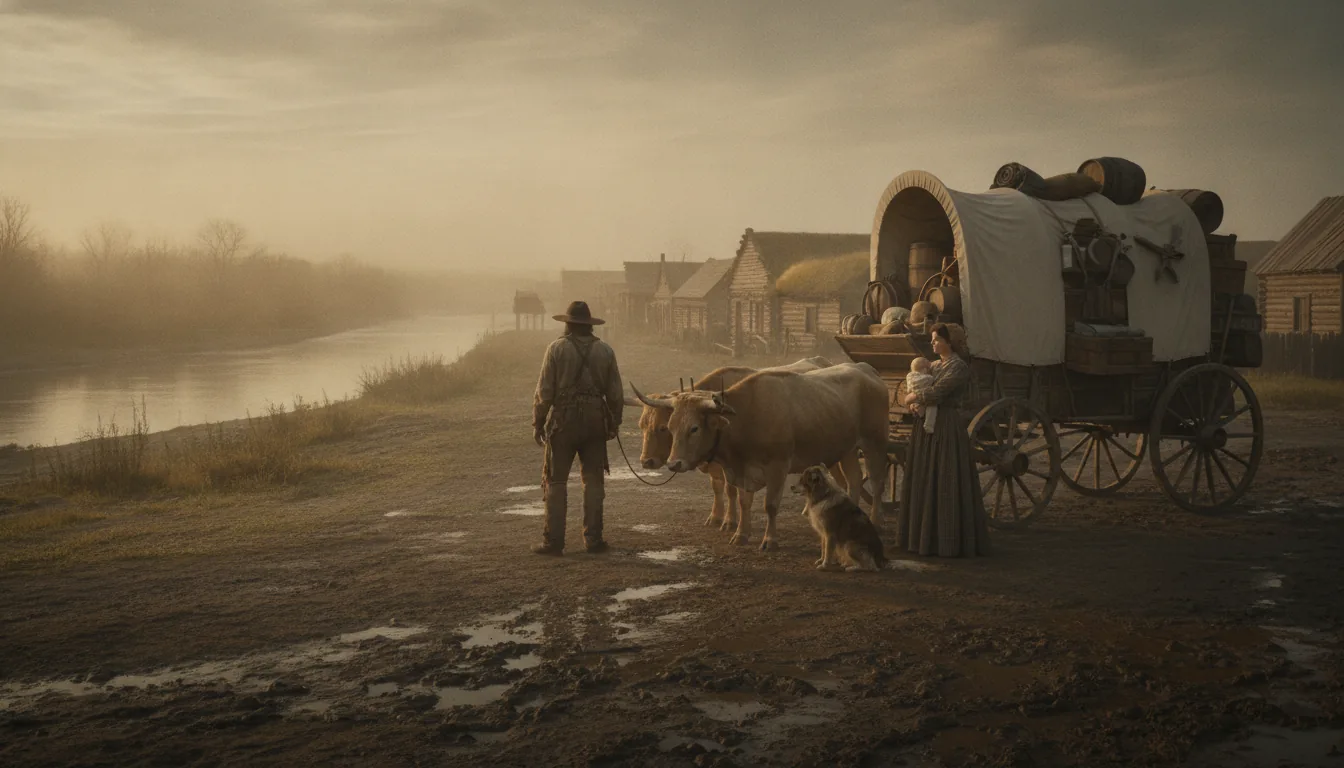
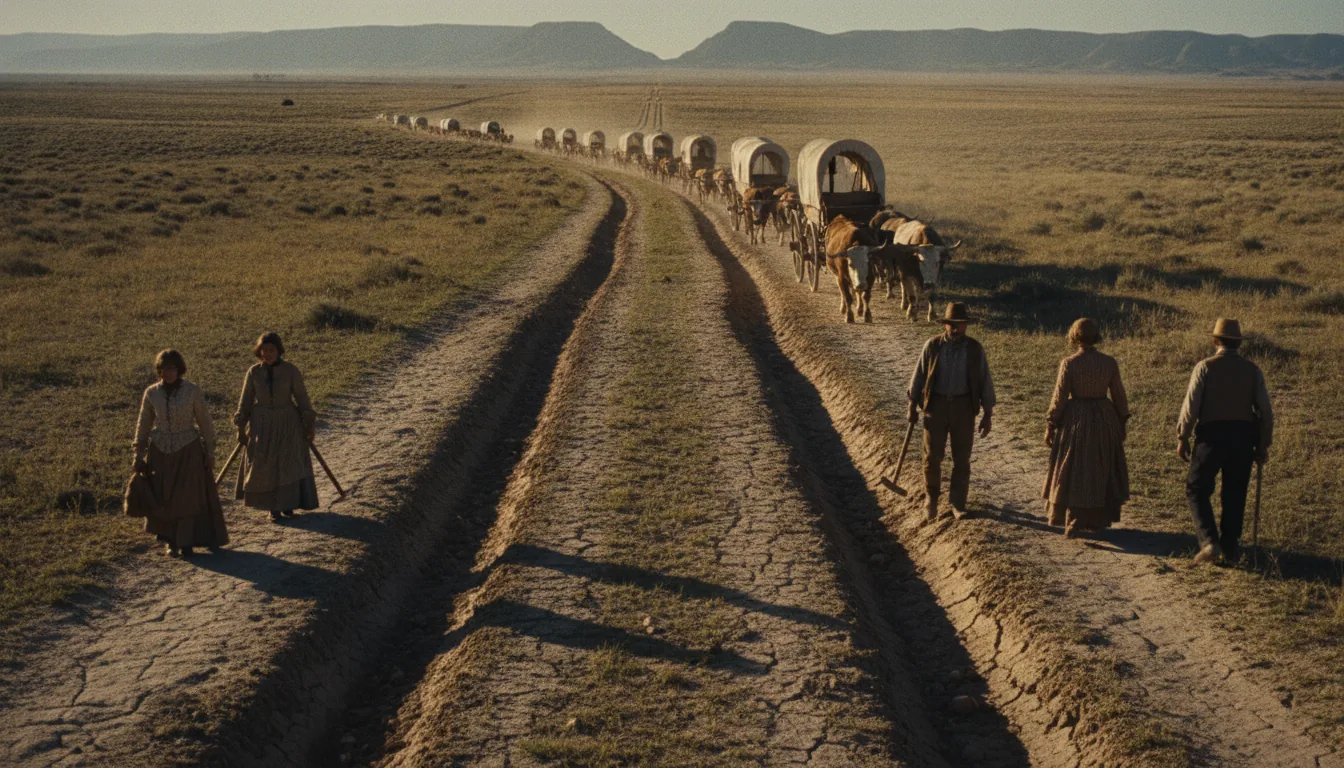
The last morning of the old life. A family and its loaded wagon at first light, about to leave the last town on the map. Everything they would own for the next half-year — and much of what they'd own for the rest of their lives — was already lashed down behind them. Reconstruction · AI-generated for this article.
The prairie schooner
A family's entire world, packed into a box on wheels.
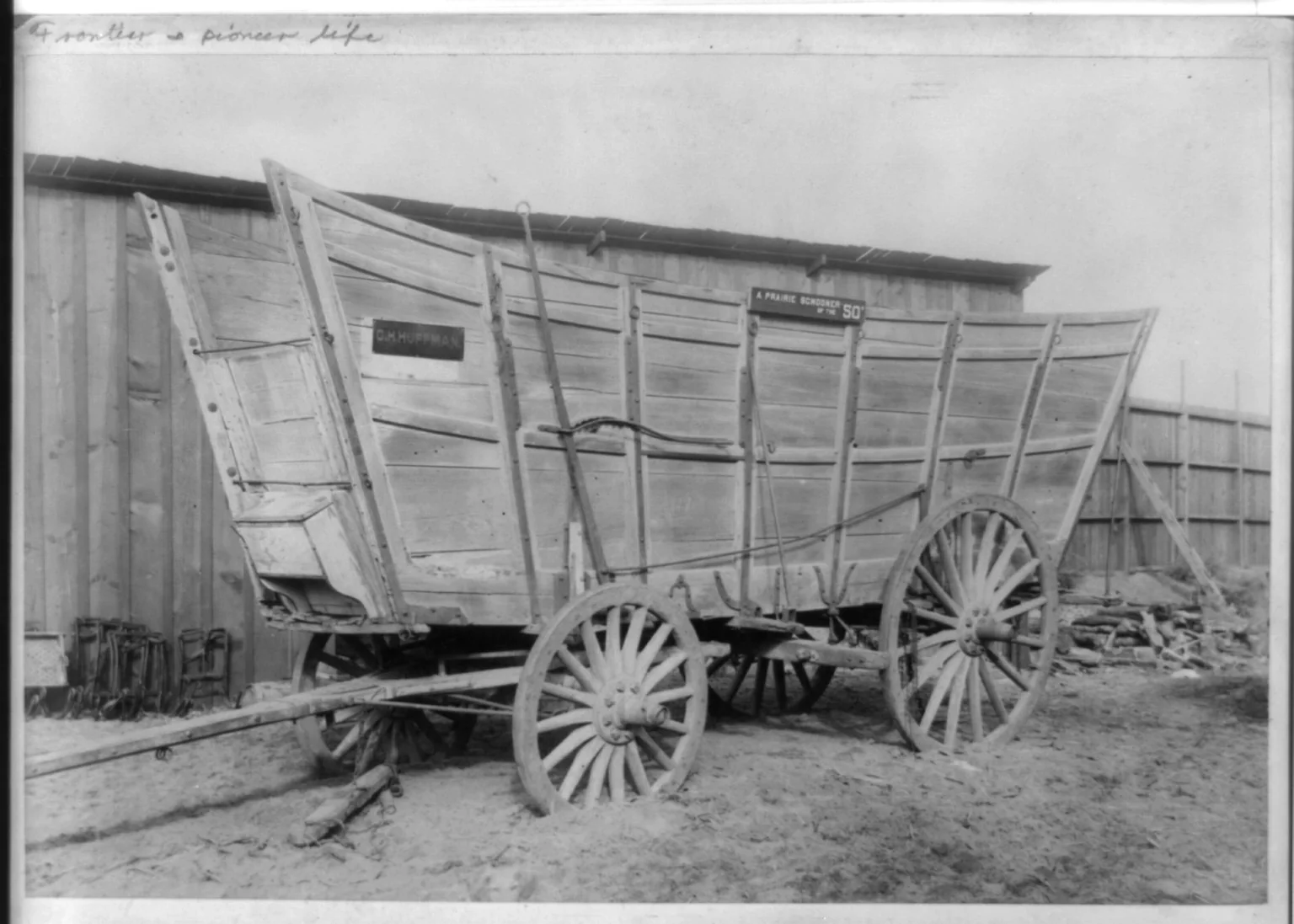
First, let's kill the most common mistake. The wagon that crossed the plains was not the big, heavy, boat-bellied Conestoga you're picturing. The Conestoga was a freight truck — a massive commercial hauler built for the short, hard roads of the East. Loading a family and 2,000 miles of provisions into one and asking oxen to drag it over the Rockies would have been madness.
The real emigrant wagon was its lighter, humbler cousin: the prairie schooner. Its bed was small — roughly four feet wide and ten to twelve feet long, about two feet deep, weighing around 1,300 pounds empty. Over the top arched a row of hickory or bent-wood bows, and stretched over those was a white canvas cover — the "bonnet" — waterproofed with linseed oil or paint. From a distance, a line of those pale bonnets bobbing across an ocean of grass looked exactly like sails on the horizon. That's the whole origin of the name: a schooner of the prairie. And the resemblance was more than poetic — a well-built wagon box could be caulked with tar, its seams sealed, and floated across a river like a squat, ungainly boat.
That last trick — the floating wagon — is worth dwelling on, because it captures how much hard thought went into this humble box. Seal the seams with tar, sometimes stretch a fresh tarred cover or a green hide beneath the bed, and a prairie schooner became a crude ferry that could pole a whole household across water too deep to ford. The bonnet earned its keep too: cinched shut at both ends with a drawstring, it turned rain, dust, and sun, and its overhang shaded the driver. Every element was the fruit of generations of practical knowledge — the tall rear wheels that climbed over obstacles, the slightly boat-shaped bed that rode up out of the mud, the hickory bows chosen because they bent under a load without snapping. The prairie schooner looked simple because a great many people had already made every mistake there was to make, so that this family wouldn't have to.
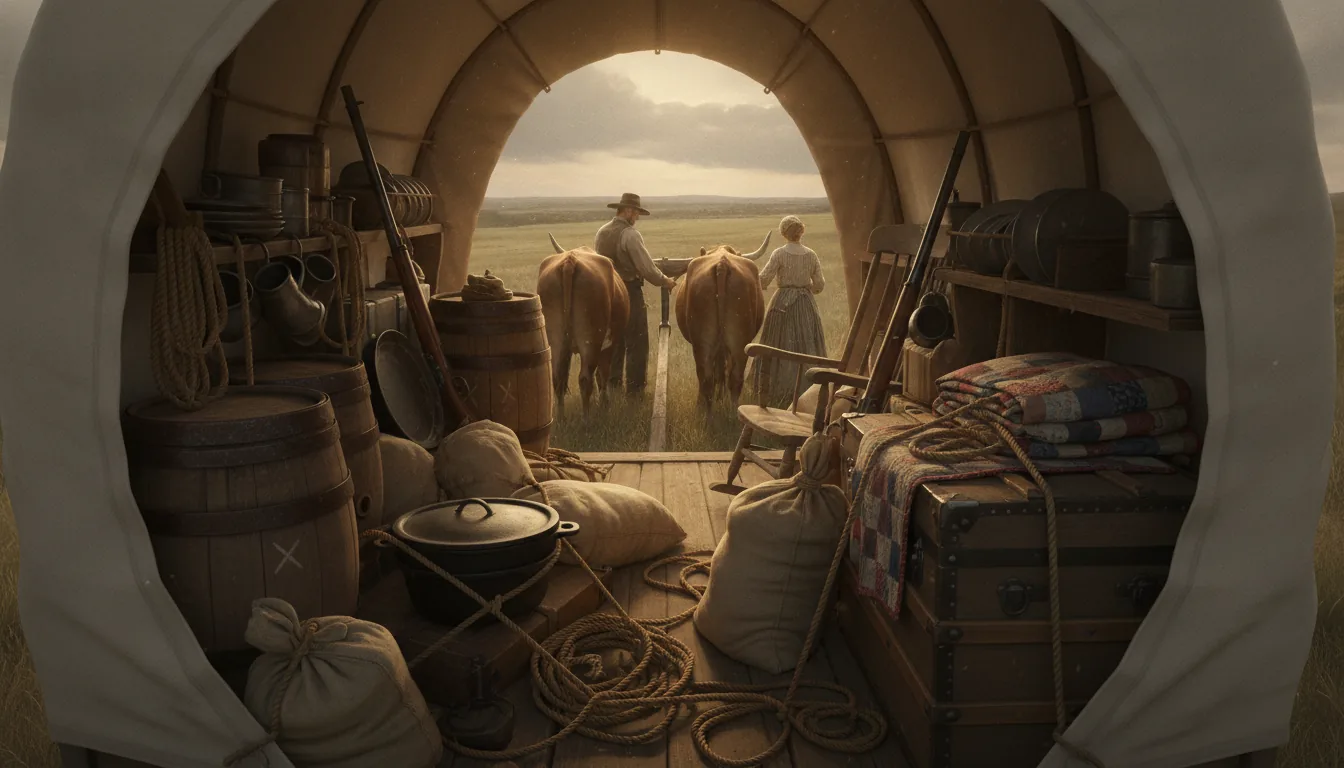
Inside that four-by-twelve box went everything. Not everything they owned — everything they could keep. A whole household, a whole farm, and half a year of meals, compressed into the volume of a modern garden shed. Every object was a negotiation against weight, and every family made the same agonizing calculations. Here is what won those arguments and rode west. Click through it.
Ten things every family fought to fit — and what the guidebooks said to bring.
An interactive cutaway. The wagon and cargo are schematic; every item and quantity is drawn from period guidebooks.
Notice what is not in there: much furniture, much comfort, much margin. A four-by-twelve box does not hold a life; it holds the seed of one. And notice the theme running through every entry — the plow, the seed packets, the tools, the fruit-tree cuttings. These families weren't packing for a trip. They were packing to rebuild an entire farm from nothing the moment the wheels stopped. The wagon was a time capsule of the life they were about to plant.
The guidebooks were merciless about discipline, because sentiment killed oxen. Captain Marcy laid out a spartan wardrobe meant to last the entire journey — for each person, two flannel overshirts, two woolen undershirts, a couple of pairs of thick drawers, four pairs of woolen socks, stout boots "coming up well at the knees" and cut large enough to guard against rattlesnake strikes, and a broad-brimmed hat. That was the whole closet, for six months. He organized cooking by "mess" — a group of six or eight who shared a single kit of one camp kettle, a coffee pot, tin plates and cups with the handles riveted on (soldered handles melted in the fire), a frying pan, and a Dutch oven. Everything beyond the essentials — the sideboard, the good china, the second trunk, the shelf of books — every honest guide told you to leave at home. Plenty of families didn't listen, packed their whole parlor, and paid for it later on a hillside in Wyoming. The wagon punished sentiment; the trail taught it.
The genuine article. A real prairie schooner — light, canvas-topped, and modest next to the freight-hauling Conestoga most people picture. This is the wagon that actually crossed the plains. Photograph 1894, I. W. Taber / Library of Congress · public domain.Inside the box. Barrels of flour, the Dutch oven, a lashed trunk, folded quilts, the rifle, the water keg — a family's whole world, roped down tight against two thousand miles of jolting. Reconstruction · AI-generated for this article.
The load
The 2,000-pound rule, and the animals that broke it.
Everything in that wagon fought against one merciless number. The box could physically hold up to two tons — but the wagon was never the limit. The animals were. A team could realistically pull between about 1,600 and 2,500 pounds of cargo across two thousand miles of prairie, river and mountain, and the widely-repeated safe maximum was right around 2,000 pounds. Load more, and you didn't break the wagon; you broke the oxen — and a family with dead oxen a thousand miles from anywhere was a family in mortal trouble.
So the whole trip became a brutal weight budget. And here is the trap that caught thousands: food had to come first, and food is heavy. A half-ton of flour and bacon before you've packed a single tool, blanket, or keepsake. Watch how little was left over once the family had to eat.
Illustrative breakdown of a ~2,000-lb family load. Food alone ate more than half.
That sliver of gold on the right — the heirlooms — is the part that would get thrown into a ditch in Wyoming. But we'll get to that. First, the decision that every family agonized over before a single wheel turned: what pulls the wagon?
There were three choices, and picking wrong could kill you. Most families, after all the arguing, chose the humblest option on the lot.
The great choice: oxen vs. mules vs. horses
🐂 Oxen
🐴 Mules
🐎 Horses
Cost
Cheapest — about $25 a yoke in 1846
Roughly twice the price of oxen
Priciest to buy and keep
Speed
~15 miles a day
~20 miles a day — a month faster
Fast, but no stamina for 2,000 miles
Feed
Thrived on raw prairie grass
Got by on rough forage
Needed grain — couldn't live on grass
Temperament
Slow, calm, patient, obedient
Tough but famously ornery
Nervous; spooked and strayed
Theft risk
Rarely stolen; easy to chase down
A prized target
The first thing stolen
Verdict
The overlander's choice — half to three-quarters of all wagons
Fast but expensive and willful
"Rarely, if ever" used to pull the wagon
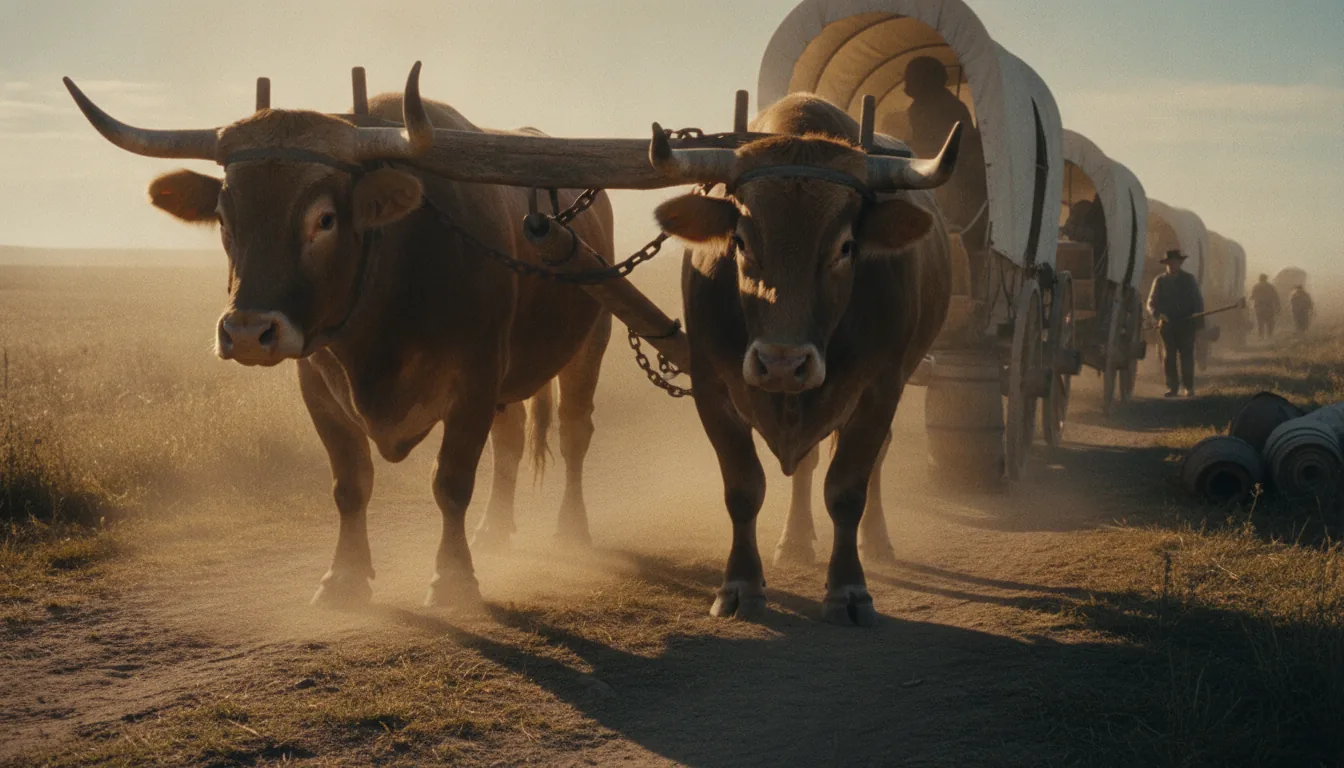
Oxen won for a stack of unglamorous reasons that all came down to survival. They were the cheapest animals on the lot. They were immensely strong — an ox can pull about twice its own weight. They could live on the grass under their own feet, needing no expensive grain. They were calm enough for a child to drive. They were far less likely to be stolen, and if they wandered, a man on a horse could fetch them back. And in the last extremity — a starving family, a failed hunt — an ox could be butchered and eaten, and it tasted like the beef it was. A mule could do none of those things, however fast it walked. As Captain Randolph Marcy put it in his 1859 guidebook, for the long haul "young oxen will endure better than mules." A family usually yoked two to four pairs — four to eight oxen — to a single wagon, plus a spare or two trailing behind to rotate in as others tired.
And here's a detail that surprises almost everyone: oxen aren't steered with reins. There was no bit, no bridle, no lines running back to a driver's hands. Instead the teamster — a "bullwhacker," in the trail's blunt vocabulary — walked on foot at the left side of the team, up near the front, and drove them with his voice and a long whip or goad, using commands worn down to single syllables: "gee" to turn right, "haw" to turn left, "whoa" to stop. A skilled bullwhacker could crack a whip like a rifle shot over the lead ox's ear without ever touching the animal, and a well-broken team would swing a two-ton wagon around on those one-word orders. It was one more reason the whole family walked: someone had to be on foot beside the oxen all day, every day, talking several thousand pounds of animal down two thousand miles of road at the pace of a slow stroll. The ox was patient — but it was not automatic. Somebody's voice moved it, mile after mile after mile.
Keeping the team alive was a daily discipline of its own. Oxen go barefoot by nature, but two thousand miles of gravel and hardpan split their hooves, so a careful family carried iron ox-shoes — little curved plates, two to each cloven hoof — and learned to throw and shoe a reluctant thousand-pound animal by the roadside. Sore-footed oxen were wrapped in rawhide "boots." The animals were rested at the nooning, grazed at every halt, and rotated with the spare yoke so that none was worked to death. An ox that died was a catastrophe; an ox that merely went lame could slow the whole company to the pace of its limp. For all the talk of pioneers, the real protagonists of the crossing had four legs and a patient eye — and the families that reached Oregon were, more than anything else, the families that had taken good care of their oxen.
The real engine of the West. Not the horse of the movie poster — the ox. Patient, cheap, grass-fed and unstoppable, a good team of oxen pulled a family and its half-ton of flour from Missouri to Oregon at a steady, plodding three miles an hour. Reconstruction · AI-generated for this article.
The road
Two thousand miles at the speed of an ox.
The wagon was loaded, the oxen were yoked, and ahead lay somewhere between 1,800 and 2,200 miles of open country — the Oregon Trail and its sisters, the California and Mormon trails, all running west together up the Platte before splitting toward their separate promised lands. At an ox's pace of ten to fifteen miles on a good day, the crossing took four to six months. Between roughly 1840 and 1869, somewhere around half a million people walked it.
Not everyone on the road was bound for Oregon or a homestead. The same great trail up the Platte carried the California gold-seekers, and it carried the Mormons — tens of thousands of Latter-day Saints fleeing persecution toward their promised land in the Salt Lake Valley, on a route of their own along the north bank of the river. Theirs was the most organized migration of all, run like a disciplined operation with advance parties, way stations, and their own detailed trail guides; and its most famous chapter was also its most harrowing, when several companies too poor for wagons crossed the last thousand miles pulling their belongings in handcarts, on foot. The overland trail was never a single stream of people. It was a braided river of them — farmers, forty-niners, and the faithful — all funneling west through the same few hundred miles of river valley and mountain pass, for reasons as different as the lives they were leaving behind.
And "walked" is the word. This is the detail that surprises everyone: the pioneers did not ride in the wagon. The wagon was full of cargo, and its iron-shod wheels turned every rut into a spine-jolting hammer blow. So the family walked — beside the team, in the dust, for two thousand miles, in boots that were usually the first thing to wear out. Children walked. Pregnant women walked. The wagon carried the flour; the people carried themselves.
The one deadline that mattered
The single most important decision of the whole trip was when to leave, and it was a vise with two jaws. Leave too early, and there was no grass yet on the prairie to feed the oxen. Leave too late, and you would reach the Sierra Nevada or the Cascades after the snow had closed the passes. The safe window was narrow — roughly mid-April into May — timed so the grass had greened but the mountains were still months away. Get the timing wrong at either end and the trip could kill you.
Everyone on the trail knew the name of the family that proved it. In 1846 the Donner Party left a little late, then gambled on a heavily-advertised "shortcut" — the Hastings Cutoff — that turned out to add about 125 miles and cost them three priceless weeks. They reached the Sierra Nevada just as the first great snows arrived, and were trapped near the summit through the winter, the drifts piling to twenty feet. Of the 87 who had set out, 47 survived, some of them only by eating the dead. The Donner Party was not a freak story to the emigrants who came after — it was the story, the reason a wagon captain watched the calendar like a hawk and drove his people hard past every temptation to rest.
A moving town with its own laws
A wagon train was not a random clump of travelers; it was an organized company, often with a written constitution, a set of bylaws, and an elected captain with real authority. The days had a rhythm: roll at dawn, a midday "nooning" to rest the animals, circle the wagons around six, and — for many companies — rest and worship on Sundays. Labor split hard along gender lines: men drove the teams, stood the night watches, hunted, and wrestled the wagons across rivers; women cooked over buffalo-chip fires, did laundry in cold creeks, minded the children, and nursed the endless sick. It was, in every sense, a small town that happened to move fifteen miles a day.
To find the way, families trusted printed guidebooks — with wildly varying results. Lansford Hastings' Emigrants' Guide was equal parts observation and salesmanship, and it was Hastings' cutoff that helped doom the Donners. The gold standard came later: Captain Randolph Marcy's The Prairie Traveler (1859), a genuinely practical manual on everything from fording quicksand to casting bullets to how much flour to pack — the book we've been quoting throughout this article.
A day in the life of the trail
Strip away the romance and a day on the trail was a grind of small, relentless labor. A shouted order rolled the camp out before dawn. The men brought in the oxen that had grazed loose overnight — an hour's work in itself, and a bad morning if any had wandered off — and wrestled the heavy yokes on while the women rekindled the fire, fried the eternal bacon, and boiled the coffee. Camp broke, the wagons pulled into line in an order that rotated daily so that no single family ate the lead wagon's dust every day, and by seven the train was creaking west.
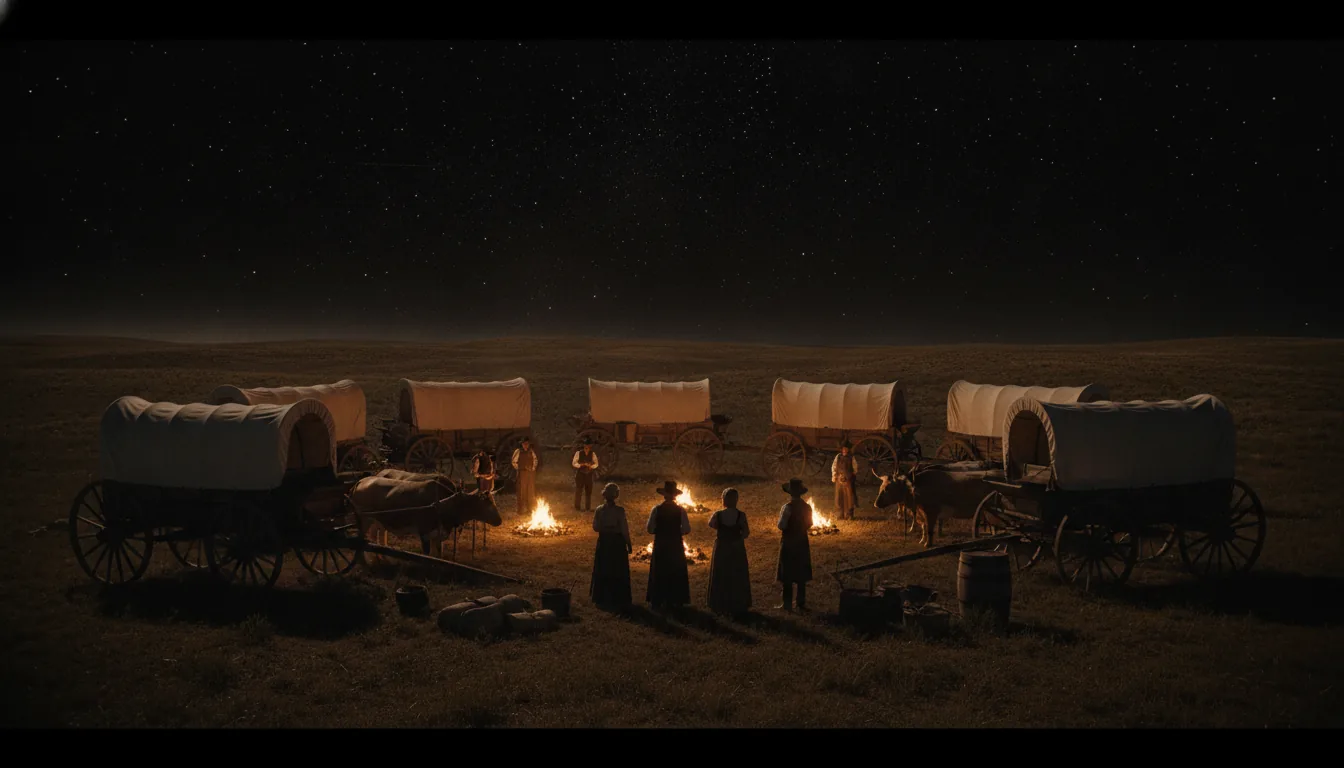
Then they walked. At midday came the "nooning," an hour or two to rest the oxen in the heat, eat cold leftovers, and let the animals graze; then on again until the captain called a halt around six. The wagons pulled into a circle — not, whatever the movies say, primarily as a fort against attackers, but as a practical corral to pen the loose oxen and cattle overnight. Inside the ring the evening's work began: more bacon, more coffee, bread baked in the Dutch oven, harness mended, diaries scratched out by firelight, children chased down and put to bed. A night watch stood in shifts against the genuine threats, which were weather, strayed animals, and the occasional thief. Many companies rested on Sundays, as much to wash and repair as to worship. Then it all started over. Fifteen miles. Again.
The food was monotonous to the point of misery: bread, bacon, beans, dried fruit, and coffee — always coffee, ground fresh and drunk strong three times a day, the one comfort nobody would surrender. Fresh meat meant a lucky hunt or a slaughtered ox; fresh vegetables were a memory, and the dried fruit in the wagon was carried as much to fight scurvy as for its taste. And there was the matter of fuel. Across the long treeless stretches of the Platte there was no wood to burn at all, so families cooked over the only fuel the plains offered in endless supply: dried buffalo dung, politely called "buffalo chips." Children were sent out with sacks to gather them, and emigrant women learned to cook a family's supper over a smoky fire of manure and think nothing of it.
Over all of it hung the dust. Tens of thousands of hooves and iron tires ground the trail to a fine powder that filled the air, coated the skin, cracked the lips, and worked into everything a family owned; travelers at the back of a big train sometimes could not see the wagon just ahead. Add the heat, the wind, the thunderstorms that could stampede the stock in an instant, the mud that swallowed wheels to the axle, and the bone-deep exhaustion of walking a marathon-and-a-half every day for months — and you have the real texture of the thing the guidebooks sold as an adventure. It was an adventure. It was also the hardest physical ordeal most of these families would ever survive.
The trail itself. So many wagons rolled the same line that they carved ruts into bare rock — grooves still visible on the plains today, a century and a half later. The trail wasn't a metaphor. It was a road worn a foot deep by iron wheels. Reconstruction · AI-generated for this article.
A good day was fifteen miles. There were four to six months of days.
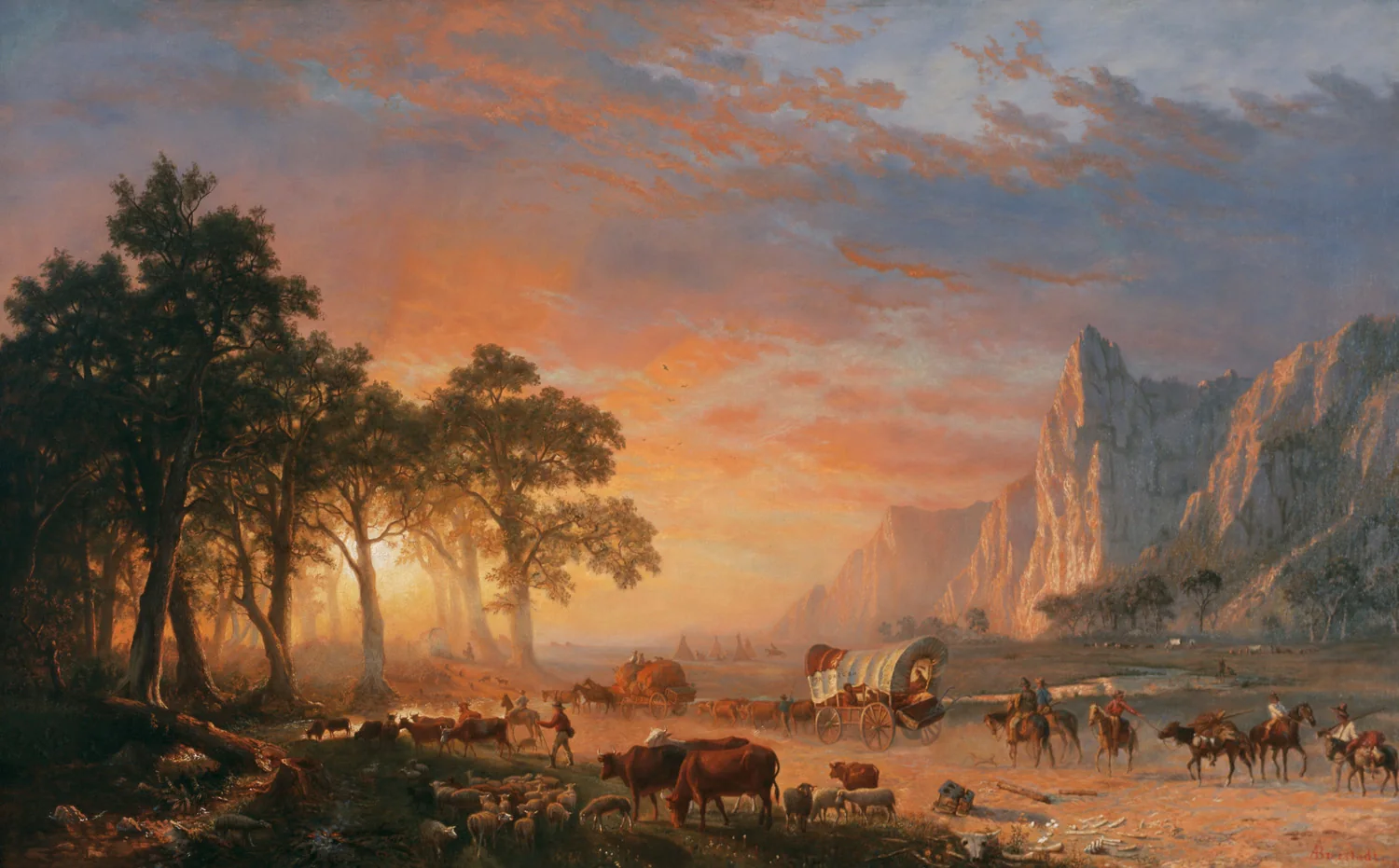
Painting: Albert Bierstadt, "Emigrants Crossing the Plains," 1869 · Library of Congress
The stops
The road, landmark by landmark.
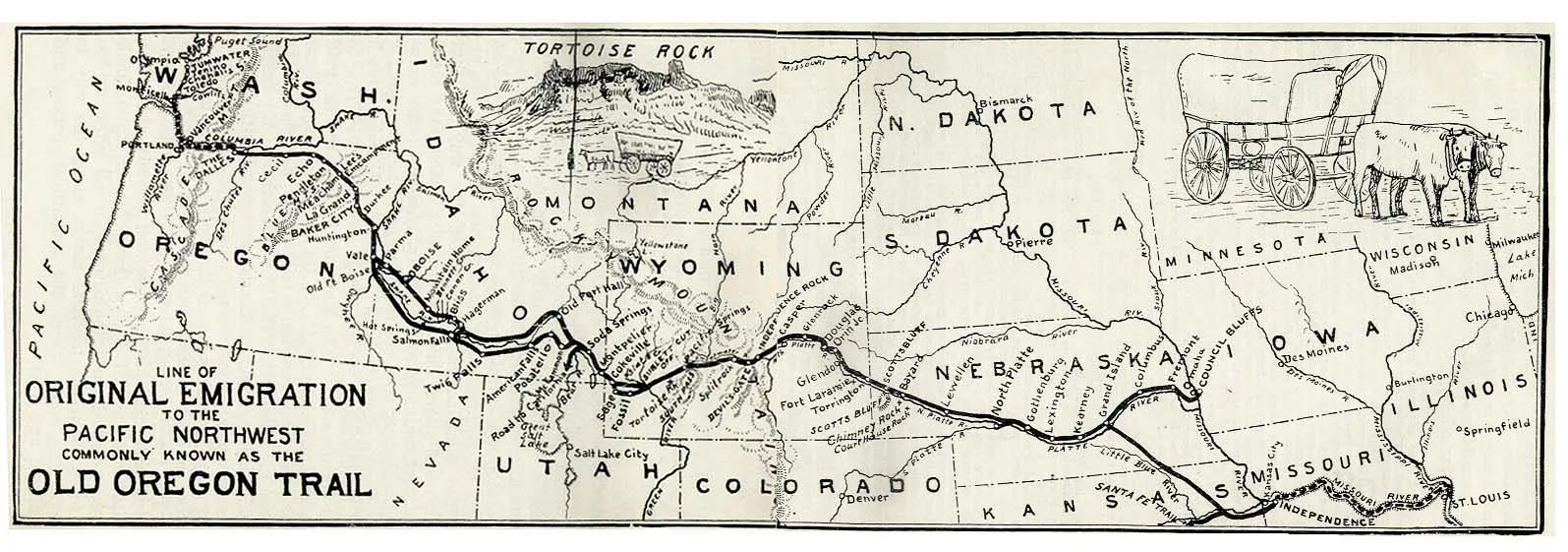
The trail wasn't a featureless slog; it was a string of landmarks, each one a milestone the emigrants measured their lives against. Reaching Chimney Rock meant the prairie was ending. Reaching Independence Rock by the Fourth of July meant you were on schedule to beat the snow. Crossing South Pass meant you had climbed the spine of the continent. Follow the whole road below — tap any stop on the map.
The route, as they mapped it. A period map of the great overland road, running up the Platte, over South Pass, and on to the Oregon country. Oregon Trail map, 1907 · public domain.
← West · Oregon & CaliforniaMissouri · East →
Tap a stop
The overland trail
Roughly 2,000 miles from the Missouri River to the Pacific slope. Follow it east to west — the way they walked it.
An interactive map. Distances are approximate; the route is the classic Oregon–California Trail.
Mile 0 · Missouri
Independence & the jumping-off towns
The wagon was bought, the oxen yoked, the flour loaded. Beyond the last plank sidewalk, the map went blank.
~Mile 300 · Nebraska
Fort Kearny
The first Army post, where every trail converged onto the Platte River road. The real crossing began here.
~Mile 550 · Nebraska
Chimney Rock
The landmark named in more diaries than any other. Its needle on the horizon meant the prairie was ending.
~Mile 650 · Wyoming
Fort Laramie
Repair, rest, resupply — a third of the way. And the place families first started throwing their heaviest treasures out.
~Mile 815 · Wyoming
Independence Rock
The "Register of the Desert," carved with thousands of names. Reach it by July 4th, or fear the mountain snow.
~Mile 915 · Wyoming
South Pass
The gentle crest of the Continental Divide — the halfway point, the roof of the continent, the point of no return.
~Mile 1,300 · Idaho
The Parting of the Ways
Northwest for Oregon, southwest for California. From here, the hardest deserts and steepest mountains still waited.
~Mile 2,000 · The coast
The promised land
The Willamette Valley, or Sutter's Fort in California — reached, at last, half a year and a lifetime after the first town.
Two of those stops deserve a closer look, because they mark the emotional poles of the whole trip. Chimney Rock was pure anticipation — a slender spire visible for two days' travel, appearing in more diaries than any other landmark precisely because it signaled that the dull, endless prairie was finally giving way to real country ahead. And South Pass was the great anticlimax that mattered more than any mountain peak. Emigrants had braced themselves to climb the Rockies; instead the Continental Divide here turned out to be a broad, gentle, twenty-mile-wide saddle of sagebrush so flat that many travelers crossed the roof of the continent without realizing it, and had to be told they were now walking downhill toward the Pacific. But everyone understood what South Pass meant. It was the halfway mark, the top of the world, and — above all — the point of no return: behind you lay the long road home, ahead lay Oregon or California and no easy way back. Families marked the crossing in their journals with a strange mix of triumph and dread.
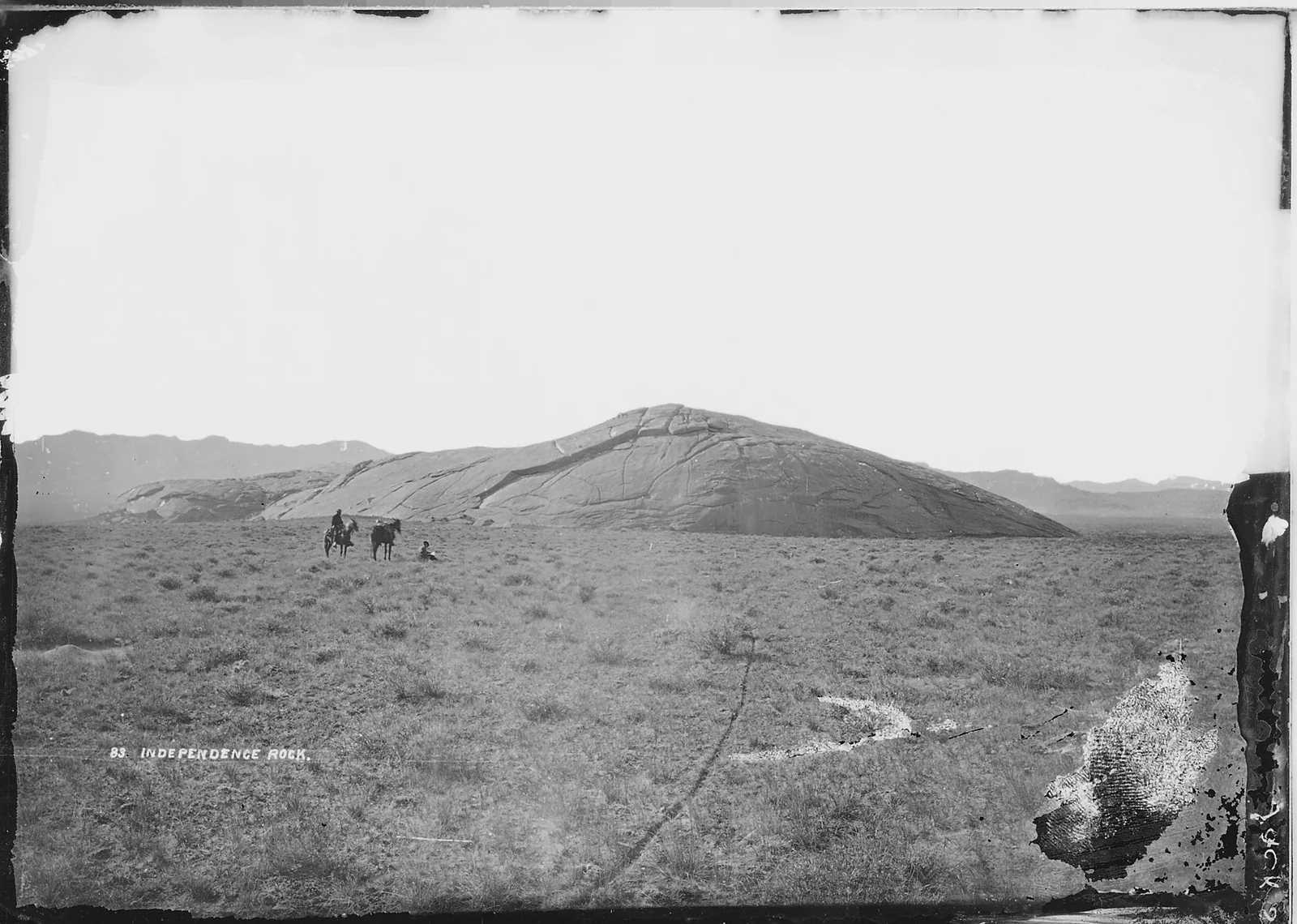
And Independence Rock was the trail's great guestbook. Emigrants climbed the giant granite whaleback on the Sweetwater and painted or chiseled their names into it by the thousands — in axle grease, tar, and paint — until a fur trapper's nickname for it, "the Register of the Desert," became the plain truth. Reaching it by the Fourth of July meant a company was on schedule to clear the western mountains before the snow, so wagon trains pushed to be there for Independence Day and often held raucous celebrations at its base: a rare, joyous pause, half a continent from home, with the names of friends and strangers rising in rows up the rock beside them. Thousands of those names are still legible on it today — a stone directory of the people who passed.
Each of those names carried a weight no map can show. Here are three of the greatest, as the emigrants themselves saw them.
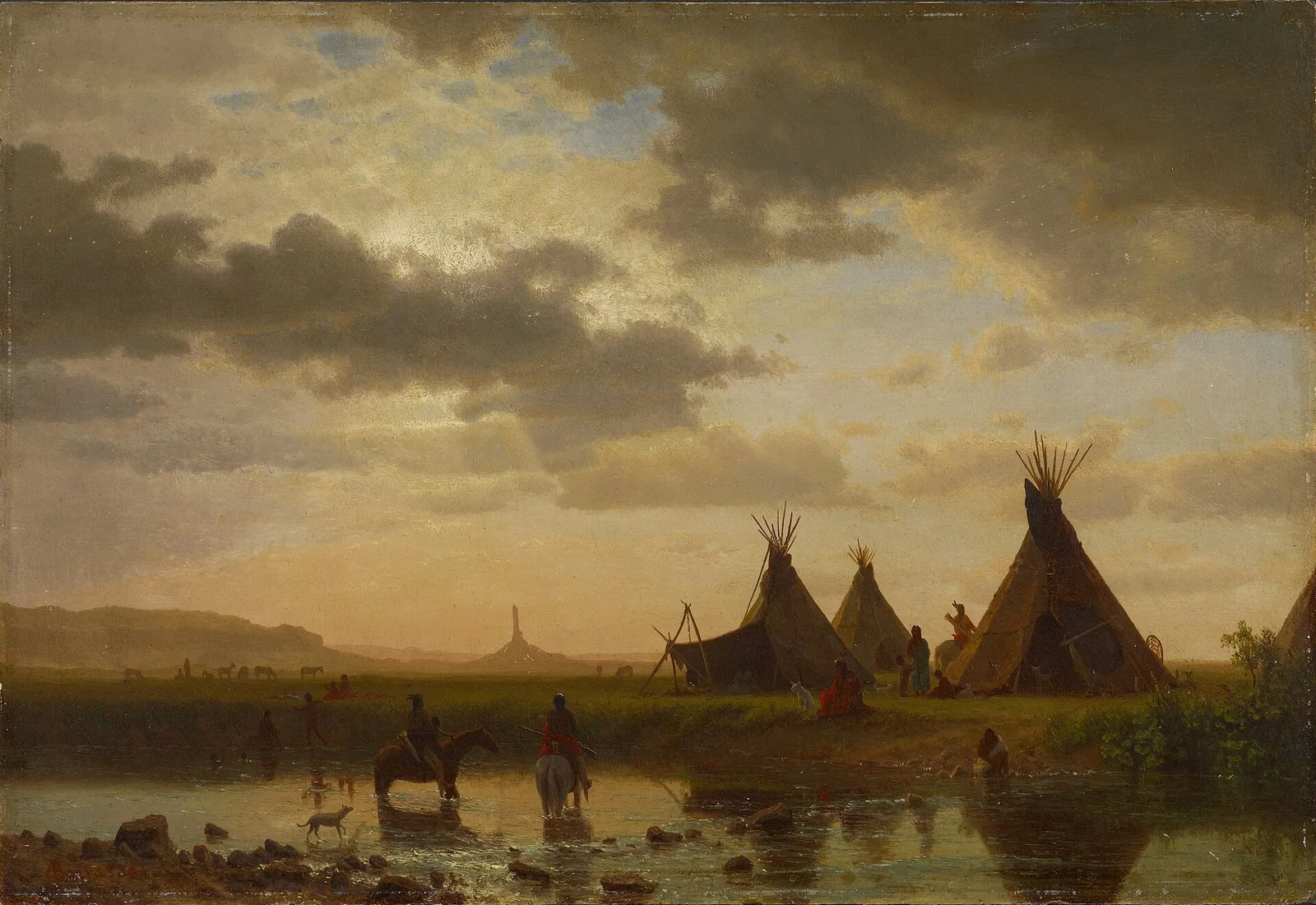
Chimney Rock. Albert Bierstadt painted it in 1860, a Lakota village in its shadow — a reminder that the "empty" trail ran straight through peopled homelands. "View of Chimney Rock," Albert Bierstadt, 1860 · public domain.
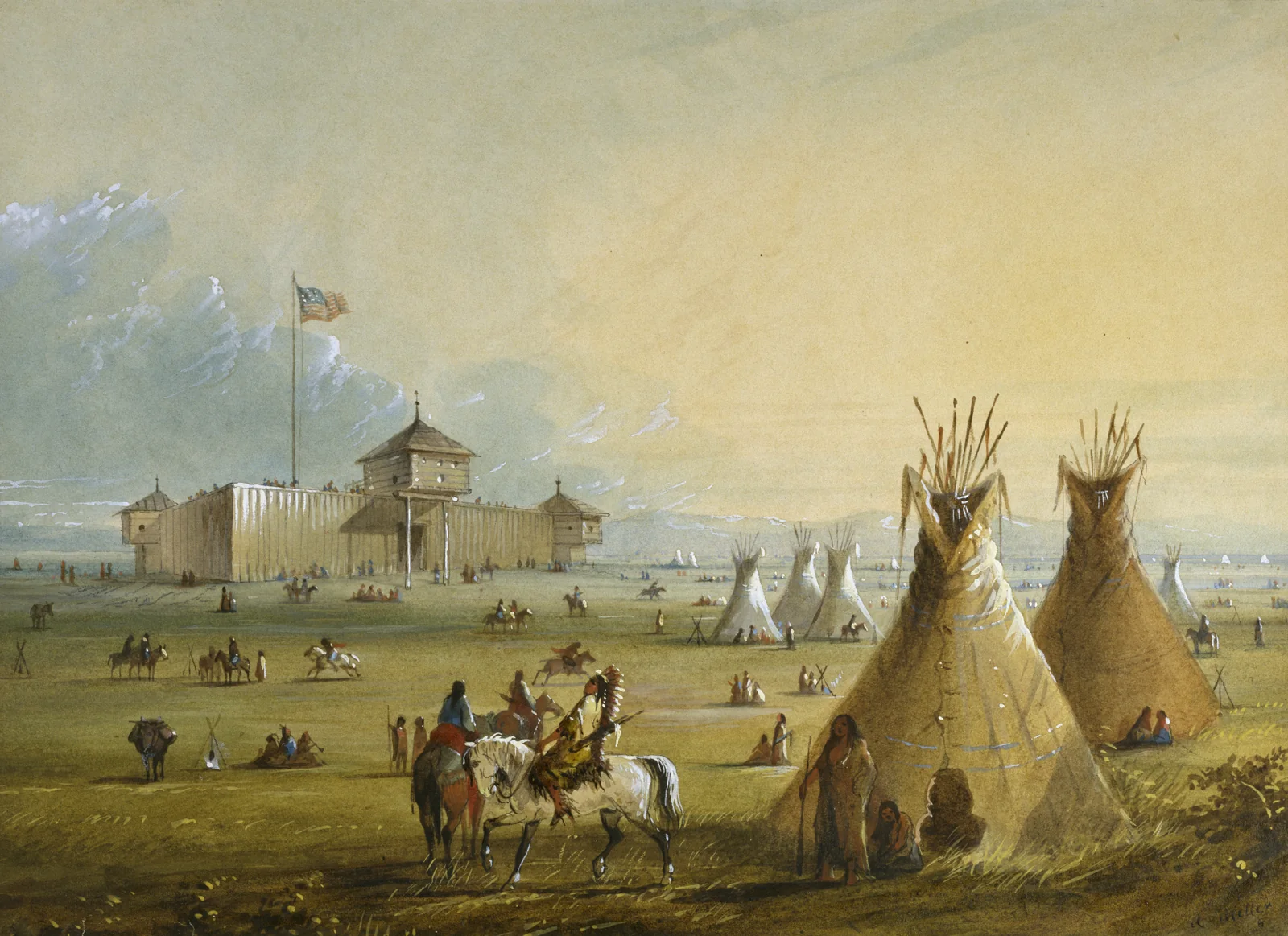
Fort Laramie. The great resupply. Alfred Jacob Miller, c. 1858 · Walters Art Museum.Independence Rock. Be here by July 4th. W. H. Jackson, 1870 · U.S. National Archives.
The dangers
Cholera, rivers, and the myth of the ambush.
Roughly one in ten people who started west never arrived. Of the hundreds of thousands who set out, as many as thirty thousand died along the way — an average of ten to fifteen graves for every mile of the Oregon Trail. But if a lifetime of movies has told you those graves were dug by war parties on the ridgeline, almost everything you picture is wrong.
The overwhelming killer was disease, and the worst of it was cholera. It moved through the crowded camps and fouled water holes like a scythe, and it was horrifyingly fast — a person could be walking beside the wagon at breakfast and buried by sundown, dead of dehydration within twelve hours of the first cramp. Its worst years were 1849 through 1855, when the Gold Rush packed the trail with people and filth. Dysentery, "mountain fever," measles and smallpox took most of the rest. The medicine chest — the quinine, the calomel, the laudanum — was useless against any of it.
Part of the horror was how little anyone could do. Germ theory was decades away; nobody yet understood that cholera rode in fouled water, so companies drank from the same befouled holes that had killed the party just ahead of them. The frontier remedies — a dose of mercury calomel, a swallow of laudanum, a shot of whiskey, a mustard plaster — treated the symptoms and sometimes hurried the end. A doctor, if a company was lucky enough to have one, could set a bone and offer comfort but could not stop an epidemic. Families learned to bury their dead fast and keep moving, because the sickness was in the camp, not the calendar, and stopping to mourn only exposed the living. It was a peculiarly modern helplessness, met with a peculiarly medieval set of tools.
After disease came accidents, and they were mostly mundane and domestic. The river crossings were the deadliest single moments on the trail: the Kansas, the Platte, the Green and the Snake drowned people and oxen by the hundreds. And then there were the wagons themselves. A child who slipped while climbing on a moving wagon could fall under those iron-shod wheels — one of the most common causes of death on the entire trail. Guns discharged by accident. People simply wore out.
The scale is hard to hold in the mind. With as many as thirty thousand dead over three decades, the trail averaged roughly a grave every eighty yards, for two thousand miles — a nearly continuous cemetery running the width of a continent. Most graves were shallow, dug in haste, and deliberately hidden: a family would drive the wagons back and forth over the fresh mound to pack it flat and disguise it, so that wolves and grave-robbers would not find it. A great many of the dead were children. The West was settled, in a real and literal sense, over the buried bodies of the people who had set out to settle it.
The diaries turn those numbers back into people. Amelia Stewart Knight crossed to Oregon in 1853 with seven children and an eighth on the way, and her journal keeps a spare, bone-tired tally of what the road cost: "Made our beds down in the tent in the wet and mud.""There were three horses and some cattle drowned while crossing this place yesterday.""A calf took sick and died before breakfast. Soon after starting one of our best cows was taken sick and died in a short time." She was writing while pregnant, on foot, cooking over buffalo chips and passing the graves of other people's children — and she bore her own baby near the end of the trail and simply kept going. Multiply her flat, exhausted entries by half a million travelers and you have the true register of the Oregon Trail: not gunfights, but wet beds, drowned stock, sick children, and the grinding daily arithmetic of endurance.
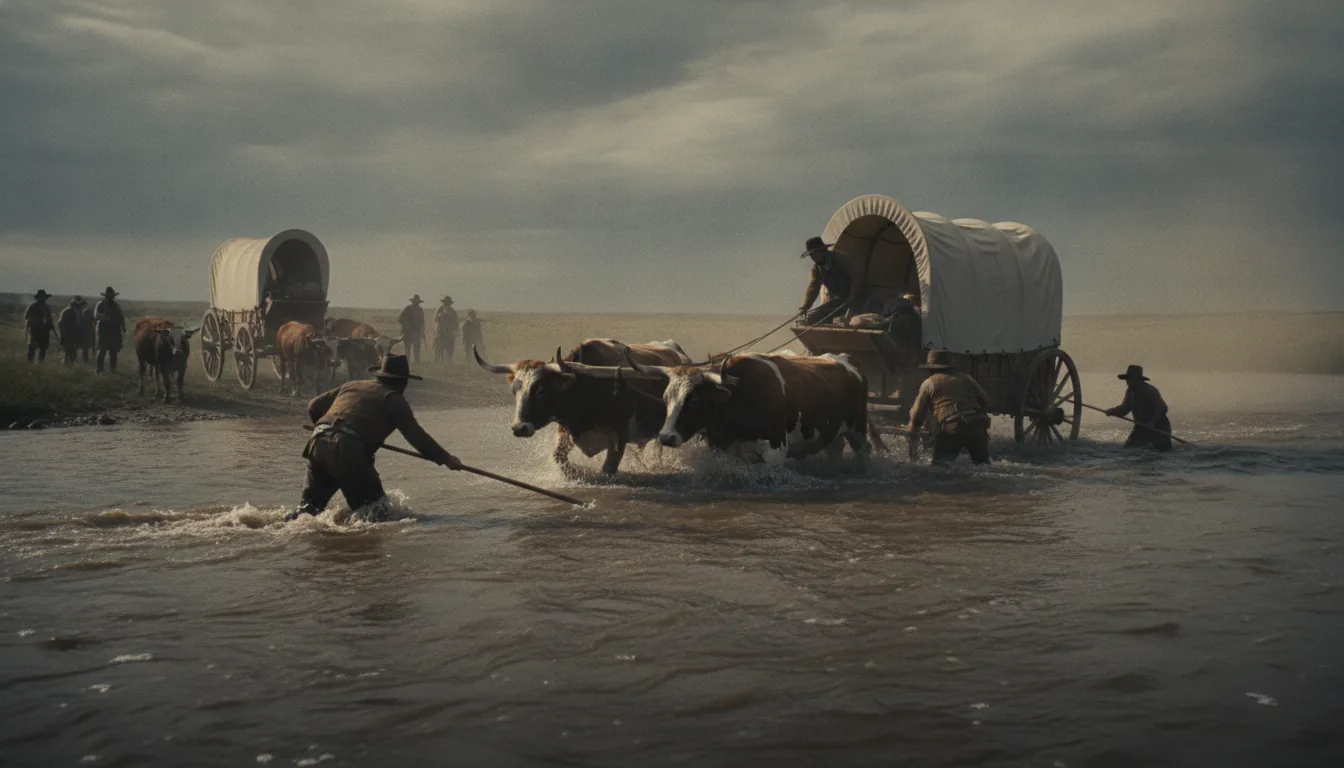
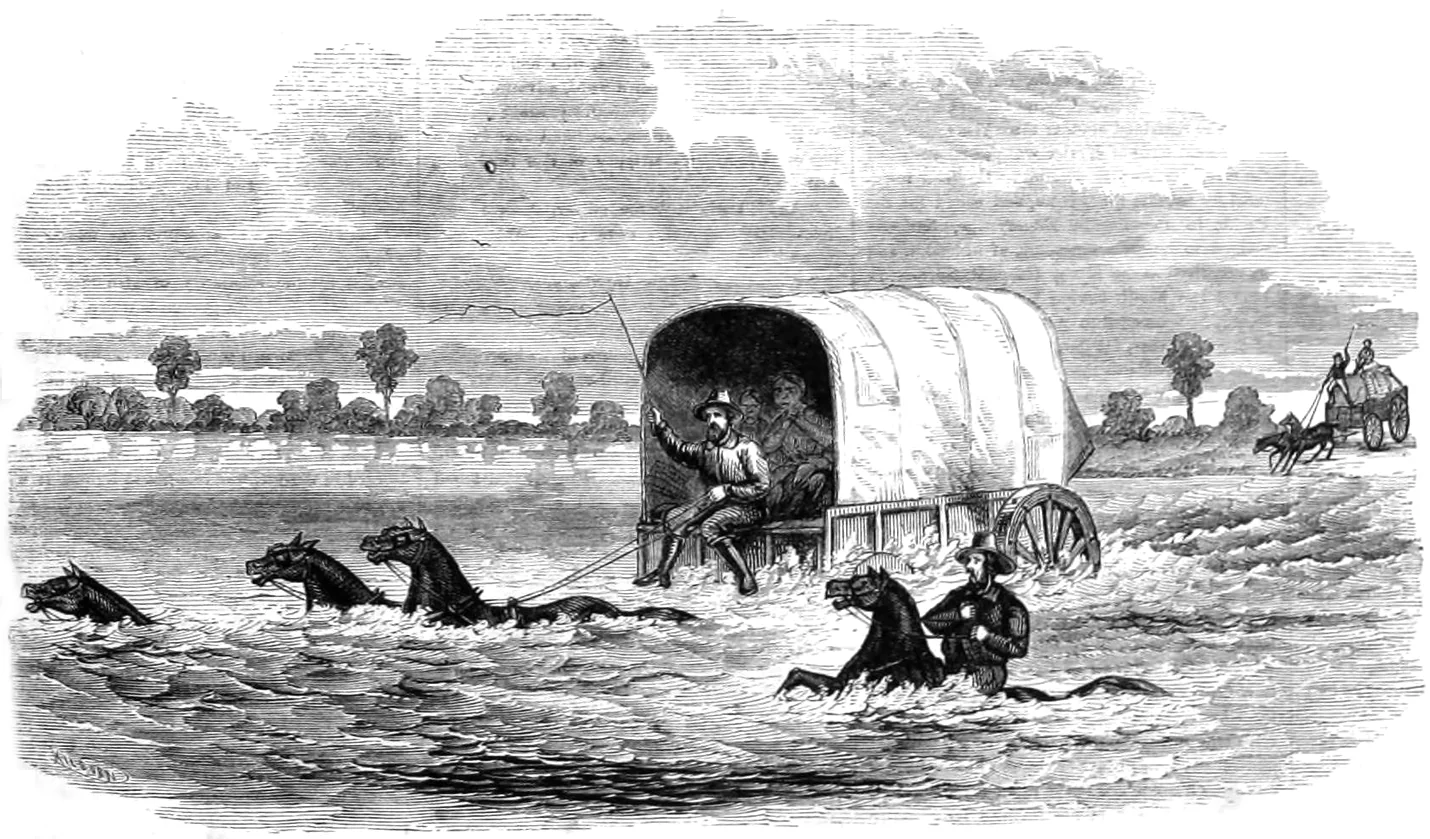
The rivers deserve their own dark note, because a crossing was the one moment when everything could be lost in ninety seconds. There were no bridges. A company reaching a swollen river had a few grim choices: pay a ferryman — often an enterprising Native operator or a Mormon crew — a stiff toll; caulk the wagon box with tar and float it across like a barge while the oxen swam alongside; or simply drive in and pray. Currents flipped wagons and pinned people beneath them; oxen panicked, tangled in the traces, and drowned still yoked to the load; a family's entire outfit could roll away downstream in an instant. The Kansas, the Platte, the Green, and the Snake each took their steady annual toll. Fording was the price of a two-thousand-mile road with no bridges, and the emigrants paid it, crossing by crossing, all the way to the coast.
The deadliest moment. The river crossings drowned people and oxen by the hundreds. Reconstruction · AI-generated.Fording the Platte. Wagons overturned; oxen tangled in the traces. Ballou's Pictorial, 1859 · public domain.
Setting the record straight
Here is where the honest history diverges hardest from the campfire version. Deaths from conflict with Native people were, by the numbers, rare. The definitive study — historian John Unruh's The Plains Across — counted the killings across the peak years of 1840 to 1860 and found that Native Americans killed roughly 360 emigrants, while emigrants killed roughly 425 Native Americans. More Native people died at the settlers' hands than the reverse. And around nine in ten of those emigrant deaths happened far out west, beyond South Pass — not on the plains of the classic ambush myth.
What actually passed between the wagon trains and the Native nations was, overwhelmingly, commerce and aid. Native people guided lost companies, operated ferries across the dangerous rivers, and sold or traded desperately-needed food, horses and information. The single biggest real friction was theft, not massacre — a stolen horse, a pilfered supply. As Unruh put it bluntly, "thievery and not murderous attack constituted the major threat posed by Indians." The emigrants of the 1840s knew this in their bones, which is exactly why one of them, in 1852, wrote the line that punctures the whole legend.
"We feared the cholera more than we did the Indians."— an emigrant, 1852
The diaries make it human. Narcissa Whitman, one of the first American women over the Rockies in 1836, described the Native people who came to meet her not as a threat but as neighbors curious about strange guests: "We ladies were such a curiosity to them. They would come in and stand around our tent, peep in, and grin." And when the trail did turn cruel, it usually did so in ways that had nothing to do with anyone's enemy. Catherine Sager was nine years old in 1844 when she fell from the family wagon and its wheel rolled over her leg. Her father's cry — "My dear child, your leg is broken all to pieces!" — is the trail's real voice of danger: a parent, a child, a wagon wheel, a thousand miles from the nearest doctor. Both of Catherine's parents would die before the journey's end, leaving seven orphaned children on the trail.
The road west was genuinely dangerous. It just wasn't dangerous in the way the legend insists. It was dangerous the way a cholera camp and a flooded river and a heavy wagon are dangerous — quietly, domestically, and by the tens of thousands.
The reckoning
Camp Sacrifice: everything they threw away.
Remember that thin gold sliver on the load meter — the heirlooms, the five percent of precious weight a family fought to keep? This is the chapter where it goes into a ditch in Wyoming.
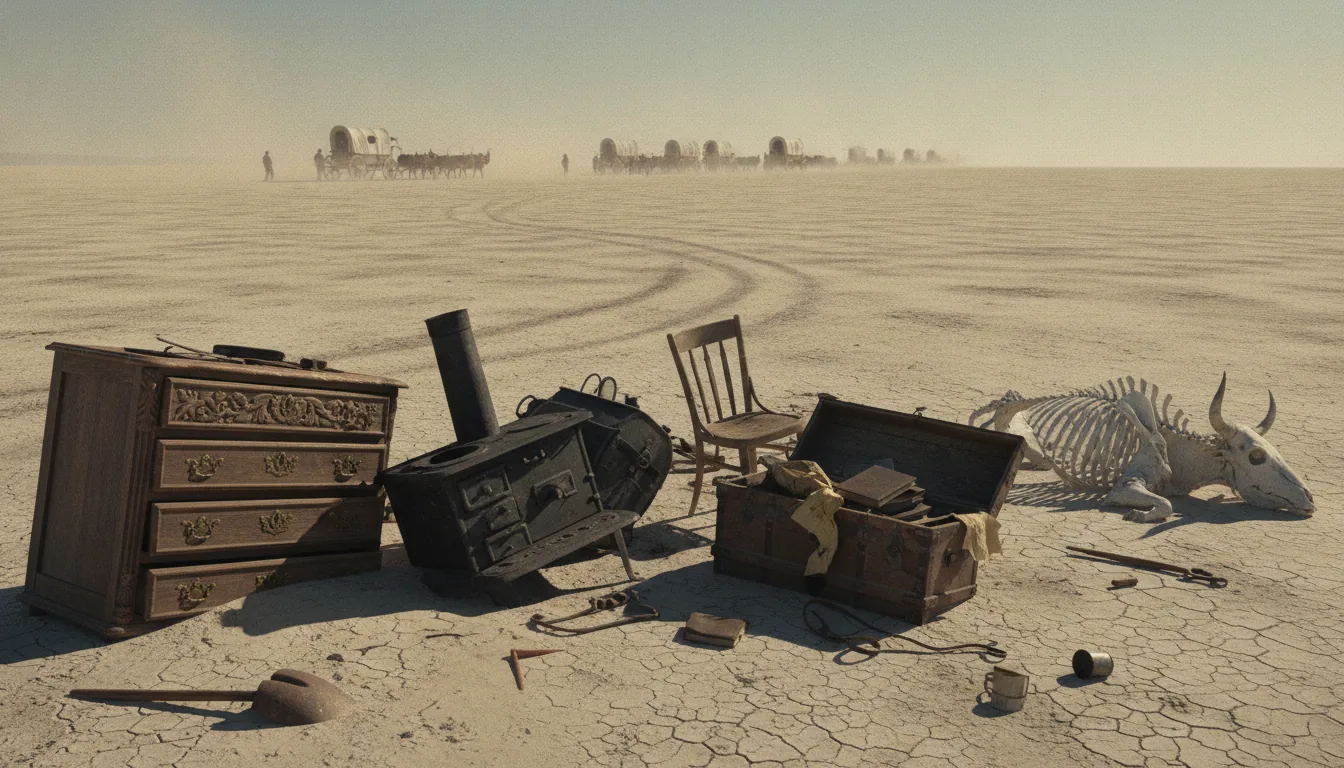
The reckoning came a few hundred miles in, usually past Fort Laramie and hard against the mountains and deserts, when the oxen began to fail. A weakening team could not haul two thousand pounds another thousand miles, and every family faced the same impossible arithmetic: the grandmother's dresser, or the animals that would get the children to Oregon alive. The dresser lost. So did the cookstove, the law books, the extra flour, and — famously — the piano that someone had hauled eight hundred miles before admitting it could go no farther.
The stuff piled up at the decision points until the trail became, in one emigrant's phrase, a winding junkyard. Fort Laramie earned a grim nickname: "Camp Sacrifice," for the drifts of abandoned furniture, chests of silver and china, stoves and heirlooms heaped around it. The pioneers even coined a word for the jettisoned treasure: "leeverite" — as in, "leave 'er right here." Enterprising Mormons in the Salt Lake Valley turned the salvage into a small industry, gathering up the leeverites and reselling them to the next season's wagons.
"Both sides of the road for miles are lined with dead animals and abandoned wagons. The owners left everything, except what provisions they could carry on their backs, and hurried to save themselves."— Margaret A. Frink, crossing the Forty Mile Desert, 1850
Nowhere was the sacrifice more total than the Forty Mile Desert of Nevada — a waterless, shadeless furnace on the California route that became the single greatest graveyard on the entire trail. A survey in 1850 tallied the toll along that one stretch: more than 1,000 dead mules, some 5,000 dead horses, nearly 3,800 dead oxen, and 953 human graves, with abandoned property valued at a staggering million dollars of the era's money. Every one of those numbers was a family's plan collapsing in the heat.
The people who saw it never forgot the sight. Captain Howard Stansbury, crossing the salt desert in 1849, wrote of "clothes, books, cases of medicine, wagon wheels, tools, &c., lay strewn about, abandoned by their owners, who had laboriously brought them two thousand miles only to throw them away." A decade later a young Mark Twain crossed the same ground and turned it into one of the most haunting passages in Roughing It.
The specifics in the diaries are almost unbelievable. One 1849 traveler near the Warm Springs, in present-day Wyoming, counted in a single stretch "eight stoves, two to three thousand pounds of flour and bacon thrown away," and reckoned he had not seen half of what lay along the road. Catherine Haun, crossing that same year, noted that abandoned wagons had become so common they were simply a convenience — her company burned them for campfire wood where the sagebrush ran thin — and recorded that her own party "were obliged to sacrifice most of our merchandise," the goods they had hauled two thousand miles to sell in California, and "left it by the wayside." Whole small fortunes in furniture and dry goods lay bleaching in the sun for anyone who could carry them off. Almost nobody could; everyone was already at the ragged limit of what their own animals could pull.
There is a particular grief buried in these piles that the casualty numbers miss. Every abandoned dresser and organ and packed trunk had been chosen — carried out of a childhood home, loaded with care in Ohio or Kentucky or Missouri, guarded across a thousand miles of jolting — and then set down gently at the roadside because a failing ox left no other choice. The objects were stand-ins for the lives being left behind: a grandmother's chair, a wedding clock, the books a family had meant to raise its children on. To walk away from them in a Nevada desert was to formally surrender the last physical piece of the old world for the bare hope of a new one. The trail's junkyards weren't carelessness. They were a continent's worth of small, deliberate heartbreaks, laid out in the sun.
The price of the mountains. A dresser, a stove, a trunk of books, spilled across the desert beside the bones of the ox that could no longer pull them. Every abandoned heirloom was a piece of the old life the family decided it could live without — because the alternative was not living at all. Reconstruction · AI-generated for this article.
"The road was white with the bones of oxen and horses ... the desert was one prodigious graveyard."
— Mark Twain, "Roughing It," on crossing the Forty Mile Desert
The homestead
Breaking ground: the reward was five years of work.
Say a family made it. Say they survived the cholera and the rivers and the deserts, rolled off the trail onto their surveyed quarter-section, and stopped the wagon for the last time. Here is the part the "free land" posters never mentioned: arriving was the beginning of the hard part. The claim was 160 acres of bare grass. No house, no well, no fence, no field. And by law, the clock was now ticking — five years to build a life, or forfeit the ground.
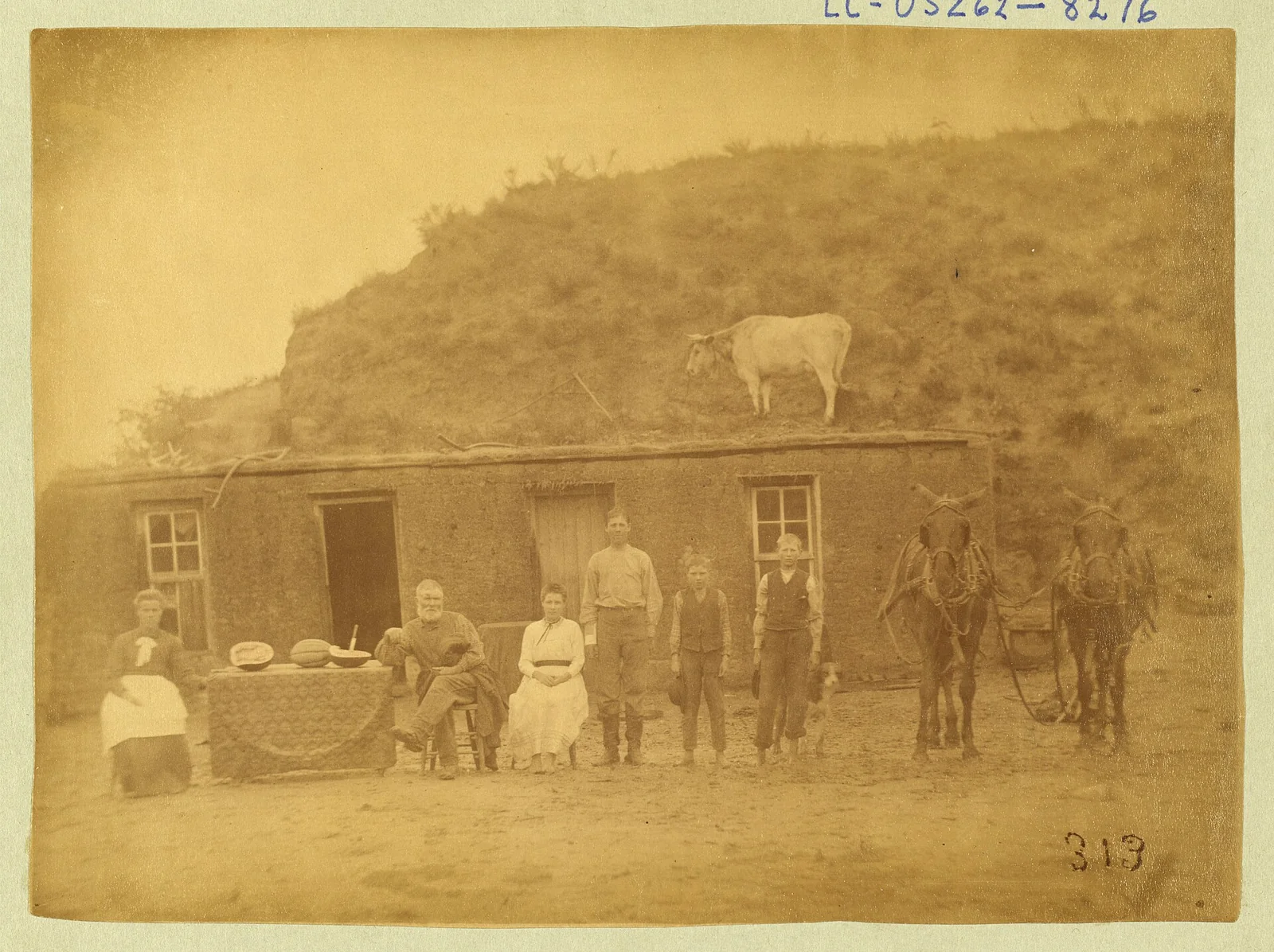
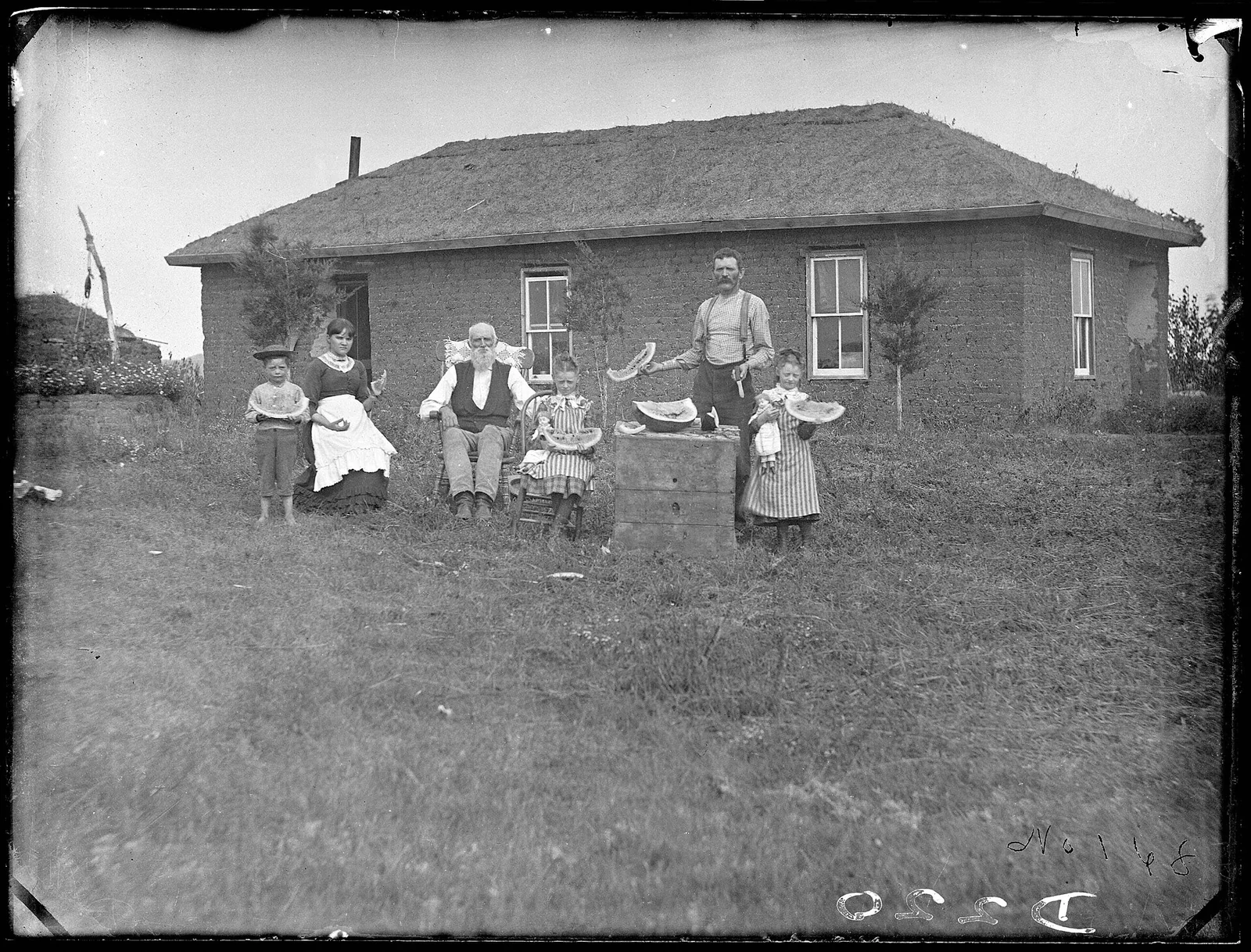
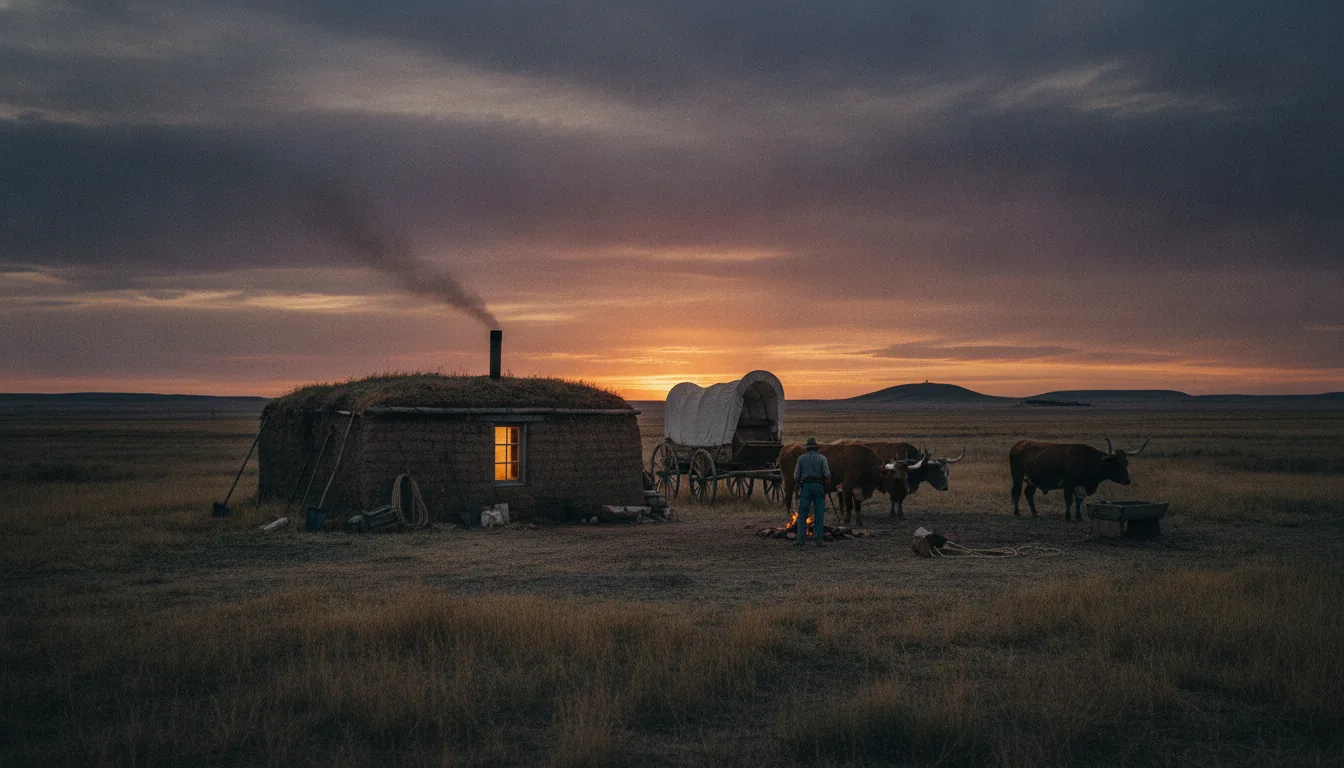
The first problem was the house, because on the treeless plains there was nothing to build one from. So homesteaders built out of the only material there was in endless supply: the ground itself. They cut the tough prairie sod into heavy bricks — settlers called it "Nebraska marble" — and stacked them into walls. The sod house, or "soddy," was cheap, fireproof, and astonishingly warm in winter and cool in summer. It was also dark, and it leaked. When it rained outside for a day, it rained mud inside for three; snakes and insects lived in the walls; and a woman might cook, sew, and raise her children under a ceiling that dropped dirt into the soup. Tens of thousands of families started American life in a house made of dirt.
A soddy went up fast and cheap, which was exactly the point. A family cut the thickest, most root-bound turf they could find — the tough buffalo-grass sod held together like matting — and a breaking plow sliced it into bricks roughly a foot wide, two or three feet long, and a few inches thick. Stacked grass-side down in staggered courses, walls two and three feet thick could rise in a week or two, pierced by a door and, if the family was lucky, a precious window or two of real glass hauled a thousand miles in the wagon. A ridgepole and a few boards carried a roof of yet more sod laid over brush or hay. The whole house might cost less than five dollars in cash — because the walls were simply the farm, stood on end.
And then a family had to live in it, which was another matter entirely. The thick walls held off the wind, the cold, and even prairie fire, and in a country with no wood and no coal that was close to miraculous. But a dirt roof sheds dirt. It dripped mud for days after a rain and sifted a fine grit into the flour, the bedding, and the baby's cradle in dry weather. Snakes and mice tunneled in the walls; women tacked muslin sheets to the ceiling to catch what fell, and whitewashed the inner walls to coax a little light into the gloom. It was dark, it was damp, and it was theirs — the place where a hundred thousand American families spent their first hard years as people who owned the ground they stood on.
Home. The Sylvester Rawding family in front of their Custer County soddy, 1886 — livestock, wagon, and a family's whole hard-won world arranged for the camera. Solomon Butcher spent decades photographing these families; his glass plates are the closest thing we have to looking the homesteaders in the eye. Solomon D. Butcher, 1886 · Library of Congress · public domain.
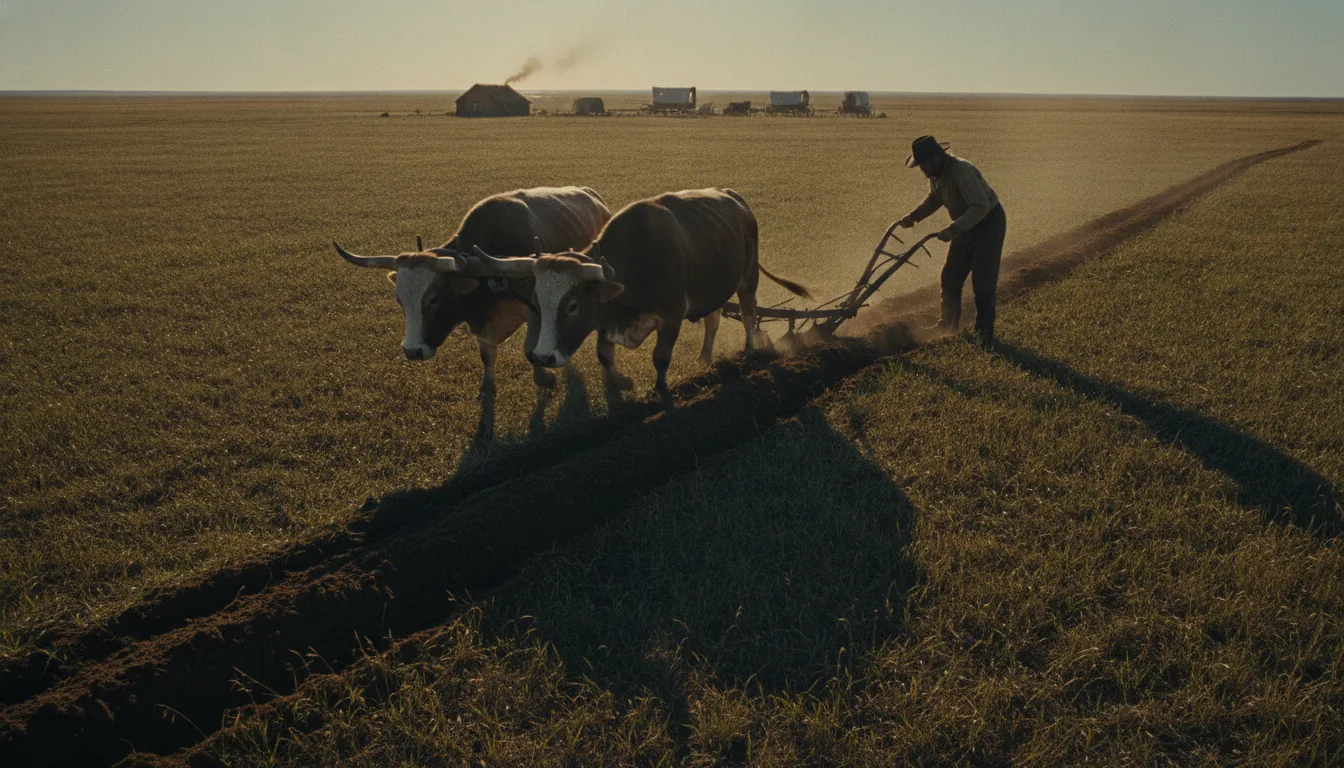
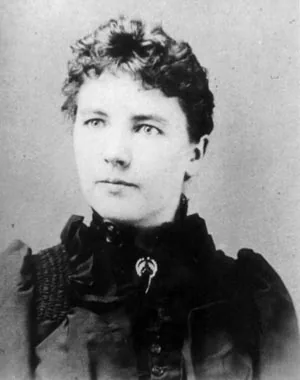
The second problem was the ground. Virgin prairie sod, matted with the roots of ten thousand years, was so tough that breaking it took a special heavy breaking plow and a straining team, and even then a man could turn only an acre or two a day. That first season was pure labor: break the sod, plant the crop, dig the well by hand, cut and stack the hay, all before the first winter closed in. And the winters could be biblical. The Hard Winter of 1880–81 buried the Dakota settlements from October to April, stopped the trains for months, and drove families to twist hay into sticks for fuel because the coal couldn't get through — the winter a young Laura Ingalls Wilder survived and later wrote into a book.
And there was everything else, all at once, in that first brutal year. Water meant digging a well by hand — sometimes thirty, fifty, a hundred feet straight down through the plains — or hauling every drop from a distant creek. Fuel, on grassland with no trees, meant buffalo chips, and when those ran out, hay twisted by hand into tight "cats" that burned fast and had to be fed to the stove almost without pause through a blizzard. Fencing had to wait on the one invention that finally tamed the open plains — barbed wire, patented in 1874. Every comfort a family had taken for granted back East now had to be conjured out of grass and dirt and sweat. The "free" 160 acres demanded, in its first year alone, a well, a house, a broken field, a winter's fuel, and a full year's food — all before the land gave back a single bushel in return.
To "prove up" — or to fail
If a family lasted five years — built the dwelling, farmed the ground, and kept body and soul together — they walked back into the land office with two neighbors, swore the final proof, paid the last few dollars, and received a patent signed in the name of the President. The land was theirs, free and clear, forever. It was one of the great democratic moments in American life: a poor family that had owned nothing now owned a piece of the country outright.
But most did not make it. Well over half of all claims failed to prove up — beaten by drought, by debt, by isolation, by the sheer brutal economics of the thing. In 1874 a plague of Rocky Mountain locusts descended on the plains in clouds that blocked the sun and ate everything — crops, harnesses, the clothes off the line — in a matter of hours. And underneath it all sat the quiet financial truth we started with: the land was nearly free, but a working farm was not. Historians estimate a family needed roughly $1,000 in that era — some $25,000 to $30,000 today — to buy the animals, seed, tools, and a year's food to bridge the gap before the first harvest. The cruel irony is that "free land" most loudly invited exactly the people — the landless poor, the freed, the newly-arrived — who were least likely to have that thousand dollars, and so most likely to fail. The homestead was a genuine ladder up. It was just a ladder with a lot of missing rungs.
The grasshopper years
And sometimes the land simply fought back. The most famous assault came in the summer of 1874, when the Rocky Mountain locust rose off the high plains in swarms so vast they were measured not in acres but in states. Survivors described a shimmering silver cloud that blotted out the sun at midday and came down with a sound like hail. What landed ate everything — the wheat and corn to the ground, then the garden, then the leaves off the trees, then the wool off living sheep, the harness leather off the wagons, the curtains, the clothes drying on the line, and the very hoe handles worn smooth by human hands. In a few hours a family's entire year was gone, and the insects lifted off leaving bare dirt behind them. Some of those 1874 swarms are reckoned among the largest concentrations of animal life ever recorded on Earth — and then, within a single generation, the Rocky Mountain locust went utterly and mysteriously extinct, one of the strangest disappearances in natural history. But not before it had broken thousands of homesteaders who never planted again.
Between the locusts, the droughts, and the killing winters, the plains ran on a boom-and-bust cycle that ground families to powder. When the rains came the settlers poured in and the towns boomed; when the dry years returned, the same wagons rolled back east with a bitter joke painted on the canvas: "In God We Trusted, In Kansas We Busted." That is the real arithmetic behind the 60-percent failure rate — not softness, but grasshoppers and drought and debt falling on people who had bet everything and had nothing left to absorb a bad year.
Even in a good year, there was the loneliness. A homestead was a full quarter-section, which meant your nearest neighbor might be half a mile off or more, and the nearest town a hard day's ride. For the men there was at least the company of the fields and the errands into town; for many women, shut in a dirt house on an ocean of identical grass, the silence became a genuine affliction. "Prairie madness" was the era's plain name for the depression and despair the emptiness could breed. The wind never stopped. There were no trees to break the horizon. A woman might go weeks without seeing a face she had not married or borne. The homestead gave a family land of its own, and asked in exchange that they endure a solitude most of us can no longer imagine.
And yet — for the four in ten who made it, the payoff was real, and it was enormous. To prove up was to walk into the land office a tenant, a laborer, or a refugee, and walk out an owner: holder of a federal patent, signed in the President's name, to 160 acres that no landlord could take and no panic could foreclose as long as the taxes were paid. Whole regions of the American Midwest and Great Plains — the farms, the county seats, the grain elevators, the churches and one-room schools — grew directly out of those proved-up claims. Tens of millions of Americans alive today descend from somebody who once lived in a house made of dirt and bet five years of their life on a quarter-section. The homestead didn't just move people west. It manufactured, on a scale nothing else in American history ever matched, the very thing the country most wanted to believe in: an ordinary family that owned its own ground.
Breaking the sod. An acre or two a day, if the team held. Reconstruction · AI-generated.Everything they owned. The Kem family, Custer County, 1886. Solomon D. Butcher · public domain.
A house of dirt, one lit window, and 160 acres of your own. For millions, it was the best deal in America.
The proved-up claim — the end of the road, and the start of everything
The people
Who actually went.
The thing that makes homesteading such an American story is who took the gamble. It wasn't one kind of person. The wagons carried failed shopkeepers and second sons, immigrants who couldn't yet speak English, women filing in their own names, and families walking out of slavery toward the first ground they'd ever been allowed to own. Here are a few of them — the famous, and the ordinary who deserve to be.
Author & homesteader
Laura Ingalls Wilder
De Smet, Dakota Territory · 1880s
The "Little House" books are autobiographical novels — but the homesteading in them was real. The Ingalls family settled at De Smet, and Laura's husband Almanzo filed both a homestead and a tree claim nearby. The Hard Winter of 1880–81, which she later wrote as The Long Winter, was no invention: the trains stopped for months and the town nearly starved.
Women homesteaders
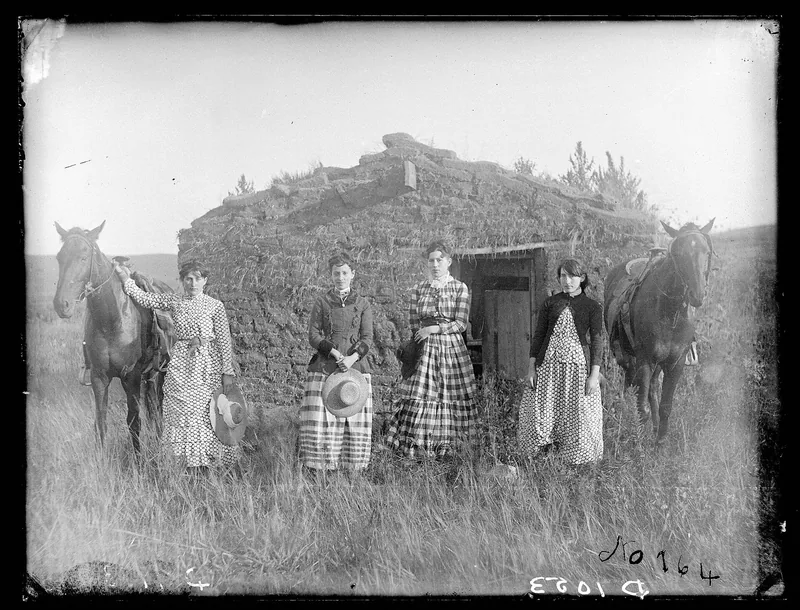
The Chrisman Sisters
Custer County, Nebraska · 1886
Harriet, Elizabeth, Lucy and Jennie Chrisman each took claims of their own, and took turns living in one another's soddies to satisfy the residency rules. Solomon Butcher photographed them on horseback before a claim shanty in 1886 — the iconic image of the American woman homesteader, filing land in her own name decades before she could vote.
The Exodusters
Nicodemus, Kansas
Founded 1877 · the western edge of freedom
As Reconstruction collapsed, as many as 40,000 African Americans — the "Exodusters," urged on by the formerly-enslaved Benjamin "Pap" Singleton — left the South for free Kansas land. Nicodemus, founded in 1877, is the only surviving all-Black homesteading town on the western plains, now a National Historic Site. For its founders, a homestead patent was the first property their families had ever legally owned.
Immigrant homesteaders
The Haumont Family
Broken Bow, Nebraska · 1886
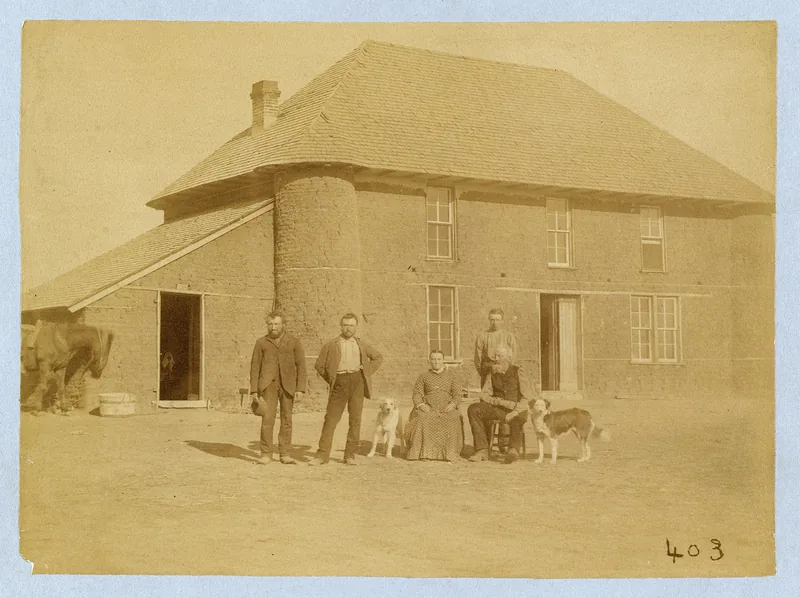
Isadore Haumont, a French immigrant, built this rare two-story sod house on the Nebraska plains. He was one of a flood: more than two million Europeans settled the Great Plains between 1870 and 1900, recruited by railroads that advertised cheap land in German, Czech and Norwegian. Over 50,000 Czechs alone settled Nebraska. The homestead frontier was, from the start, spoken in a dozen languages.
And then there are the ones who homesteaded before history knew their names. Before he was the most celebrated agricultural scientist in America, George Washington Carver was a homesteader: in 1886 he filed on a claim near Beeler, in Ness County, Kansas, built himself a sod house, broke seventeen acres, kept a small flock of hens, and planted hundreds of trees on the bare prairie before he ever set foot in a laboratory. The man who would remake Southern agriculture learned the land, first, on his own 160 acres.
Carver's homestead didn't make him rich — drought and the sheer difficulty of the Ness County claim eventually pushed him back toward school, and on to the science that made him famous — but it marked him. The man who would later teach the South to rebuild its ruined soil had first wrestled a living out of raw Kansas prairie with his own hands, in a house he had cut from the sod. He's a reminder that the homestead frontier wasn't only where families went to farm. It was where a great many Americans first got the toehold — the bit of ground, and the bit of standing that came with it — that let them go on to become whatever they became next.
The women's story runs deeper than four sisters on horseback. Under the Homestead Act, more than 100,000 women filed and proved up claims in their own names — single, widowed, and divorced women who, in an age when a married woman could scarcely sign a contract, could walk into a federal land office and walk out holding title to a piece of the United States. In some western counties, women were one in five of all homesteaders, and they proved up at rates as high as the men. One of them, Elinore Pruitt Stewart, answered a Denver newspaper ad, homesteaded in Wyoming, and turned her letters home into a small classic — Letters of a Woman Homesteader (1914) — that still captures the strange, hard exhilaration of a woman who owned her own ground.
It is worth pausing on how radical that was. In much of nineteenth-century America a married woman's property legally belonged to her husband; she often could not sign a contract, keep her own wages, or sit on a jury. Yet the federal land office would hand an unmarried woman a patent to 160 acres on precisely the same terms as any man — and tens of thousands of women seized the opening, filing claims, raising their own soddies, breaking their own sod, and proving up at rates that matched or beat the men around them. Some did it for independence, some for the land's cash value, some simply because it was the best deal on offer to a woman alone. For a widow with children, or a young woman with no inheritance, a homestead was something almost no other American institution would give her: property, and the standing that came with it, held in her own name and answerable to no husband. The frontier, for all its brutality, quietly handed a great many women the first real economic power they had ever known.
The railroads sold the frontier
The homesteaders did not simply appear on the plains; in enormous numbers, they were recruited there — and the great recruiters were the railroads. To build the transcontinental lines, Congress had granted the railroad companies tens of millions of acres of public land in a vast checkerboard along their tracks, and those companies now needed one thing above all else: paying settlers to fill the empty country their trains ran through. So the railroads became, in effect, the largest immigration agencies on Earth.
They advertised the American West across Europe with a fervor that would embarrass a modern marketer. The Burlington & Missouri and its rivals printed glowing circulars in German, Czech, Norwegian, and Swedish; they stationed agents in Hamburg and Liverpool and in the mountain villages of Scandinavia; they promised rich land for under two dollars an acre and ran discounted "immigrant trains" that carried the newcomers and their trunks straight from the eastern docks to the frontier depots. Back home, the letters those first settlers wrote — the famous "America letters" — did the rest, pulling whole villages across the ocean one family at a time.
It worked on a staggering scale. More than two million Europeans settled the Great Plains between 1870 and 1900, until whole counties spoke German or Norwegian or Czech and the country church and the mother tongue traveled west intact. Over fifty thousand Czechs alone settled Nebraska, giving the state the highest per-capita Czech population in the nation; Scandinavians filled Minnesota and the Dakotas; German-Russians carried in the hard winter wheat that would remake the plains into the breadbasket of the world. The "American" homesteader in the sod-house photographs was, as often as not, a Norwegian who had been on this continent for eighteen months and was building a farm in a language the land-office clerk could not read.
Put them together — the immigrant with his two-story soddy, the sisters trading nights to hold their claims, the Exoduster family that walked out of the South, the future scientist behind his plow — and you have the truest picture of what the Homestead Act actually did. It was the widest door to property ownership the country had ever opened. The next chapter is about the door it slammed shut.
The honest part
The land was never empty.
A history of homesteading that stopped here would be a lie of omission, and this registry stakes its name on honesty. So, plainly: the 270 million acres the government gave away were not unclaimed wilderness. They were the homelands of many Native nations, and they became "public land" available to homesteaders only because the United States had first taken them — through treaties that were frequently coerced and later broken, through forced removal, and through military conquest that pushed those nations onto reservations. Native people, in a bitter irony, generally could not file homestead claims themselves unless they renounced their tribal citizenship.
The dispossession did not end when the wagons arrived; a law finished the job. The Dawes Act of 1887 broke communally held reservation land into individual allotments and declared everything "left over" to be surplus — to be sold, much of it, to white settlers. Over the next half-century, Native land holdings fell from roughly 150 million acres to about 48 million. Around 90 million acres — two-thirds of the remaining tribal land base — passed out of Native hands.
Both of these things are true at once, and the honest account holds them together without letting go of either. Homesteading genuinely opened land ownership to poor families, immigrants, women, and the formerly enslaved — people the rest of American life kept locked out. And it was built, from the first surveyor's stake, on taking a home from someone who was already there. The free quarter-section was real. So was the price somebody else paid for it.
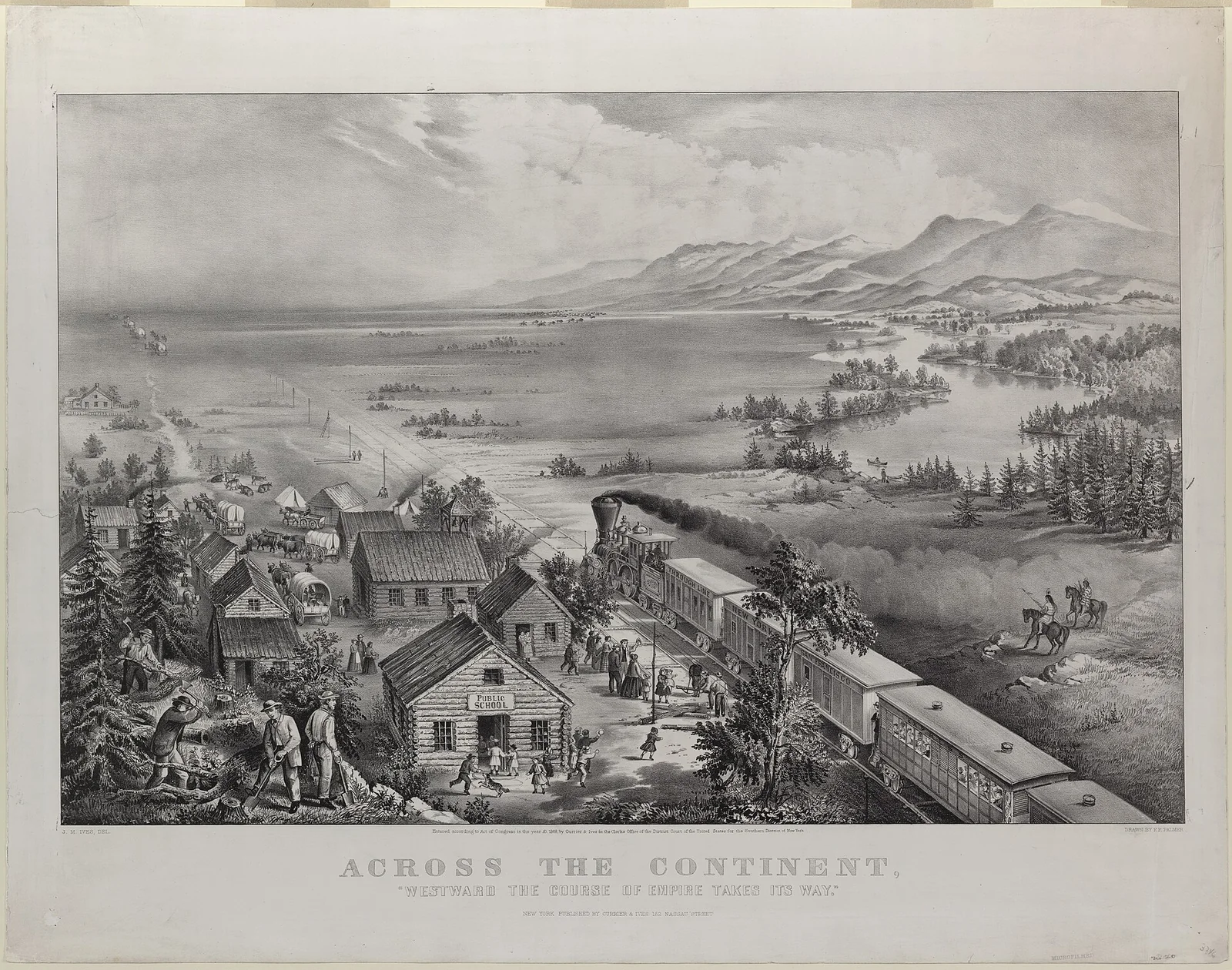
The story America told itself. Currier & Ives, 1868 — the settlement and the railroad drive west into the light, while two Native riders sit apart in the smoke. The print called it "the course of empire." It is worth seeing exactly how the era pictured its own expansion, and who it drew standing on the far side of the tracks. "Across the Continent," Currier & Ives, 1868 · Library of Congress · public domain.
We tell it this way not to diminish the homesteaders' courage — which was real, and staggering — but because a frontier's history is only worth trusting if it includes everyone who stood on the ground. Which brings us, at last, to a frontier where that particular tragedy cannot repeat: one with no prior inhabitants at all.
The bookend
The last homesteader — and the frontier that comes next.
The Homestead Act outlived almost everyone who wrote it. It stayed on the books for 123 years. Homesteading in the lower forty-eight ended only with the Federal Land Policy and Management Act of 1976 — and Congress carved out a single exception for Alaska, the last great expanse of unclaimed federal land, good for ten more years.
So the final chapter of a law born in the Civil War was written not in a stampede but by one man alone in the bush. In 1974, a Vietnam veteran named Ken Deardorff filed on about eighty acres along the Stony River in southwestern Alaska. He did exactly what the Act had always asked: he lived on the land, built on it, worked it, and filed his final proof in 1979. Then he waited. His patent — the very last one issued under the Homestead Act, the last of roughly 1.6 million — was not signed until May 5, 1988. His claim was real on the ground in 1974; the recognition took fourteen years to catch up.
Hold that gap in your mind, because it is the whole point. On every frontier in this story, documented, good-faith possession came first and waited, sometimes for decades, for an authority to arrive and bless it. The homesteader's claim was real the day it was filed, not the day the patent printed.
The earthly frontier is closed now. Every acre is surveyed, owned, fenced. But look up: there is a new frontier overhead — the Moon, and Mars — silent, unmapped in any deed book, and, for the first time in the history of frontier land, home to no one who could be displaced. There is no land office up there. No authority exists today that can grant title beyond Earth, and the 1967 Outer Space Treaty makes sure of it. Anyone who sells you a "deed" to a lunar crater is selling a novelty.
What can be done is the oldest thing in this entire history — the part that always came before the paper: a defined parcel, a timestamped and public claim, a statement of good-faith intent to use the land, and a record kept faithfully over time. That is what Red Homestead builds, and we tell you plainly what it is and is not. Not a title. Not an investment. The strongest documented good-faith forward claim a person can make on off-world ground today — assembled from the very frontier mechanisms this article just walked through.
Read this whole history back and the parallel is almost uncomfortable. A frontier opens. No authority yet exists to hand out title, so the only thing a person can actually do is show up, define a parcel, occupy it in good faith, improve it, and — above all — document it: keep a faithful, public record, and wait, sometimes for years, for recognition to arrive. That is the homesteader's story stripped down to its mechanism, and it is almost exactly the position of anyone serious about the Moon or Mars today. The homesteaders had one advantage we've lost — an authority did, eventually, come. But they faced the same core task, and they teach the same lesson: that the ground goes, in the end, to whoever combines genuine presence with the best-kept record. We didn't invent that idea. We just carried it, honestly, to the next frontier — and wrote down exactly what it is, and what it isn't.
The continent was won by the people who showed up, did the work, and kept the best records. That has not changed. Only the horizon has.
Keep reading
The companion to this piece — Where Title Comes From — traces the legal machinery behind the homestead: livery of seisin, Crown grants, the Spanish ranchos, the 1872 mining law, and the survey-and-patent system that turned occupation into ownership.
Dates, figures and quotations in this article are drawn from public and scholarly sources — the National Park Service and Homestead National Historical Park, the National Archives, the Bureau of Land Management, the Oregon-California Trails Association, Randolph Marcy's The Prairie Traveler (1859), John Unruh's The Plains Across (1979), and state historical societies — and are summarized for a general reader. Some celebrated "firsts," notably the first homesteader, are traditional honors more than provable facts, and we have flagged them as such. Historical photographs are in the public domain, sourced from Wikimedia Commons and the Library of Congress and credited below; several cinematic scenes that no surviving photograph records were reconstructed with AI and are labeled where they appear. Nothing here is legal advice, and nothing represents that land on the Moon, Mars, or any celestial body can presently be owned, sold, or legally titled. See our full legal & disclaimer.
Image credits
The Homestead Act, 1862 (original document). U.S. National Archives.
Daniel Freeman portrait (1904) and his 1863 homestead application. Library of Congress / National Park Service.
Sod-house families — Rawding, Kem & Haumont (1886) and the Chrisman Sisters (1886). Photographs by Solomon D. Butcher, Library of Congress.
Prairie schooner, 1894. I. W. Taber, Library of Congress.
"Emigrants Crossing the Plains" (1869) and "View of Chimney Rock" (1860). Albert Bierstadt.
"Fording the Platte at High Water," Ballou's Pictorial, 1859.
Fort Laramie, Alfred Jacob Miller (c. 1858), Walters Art Museum. Independence Rock, William Henry Jackson (1870), U.S. National Archives.
Nicodemus homesteaders (c. 1890), National Park Service. Laura Ingalls Wilder portrait (public domain).
"Across the Continent" (Currier & Ives, 1868) and the Oregon Trail map (1907). Library of Congress.
All historic images are in the public domain, sourced via Wikimedia Commons. Cinematic scenes for which no photograph survives were reconstructed with AI and are labeled where they appear.
Important legal disclaimer
No conveyance of legal title. The 1967 Outer Space Treaty (Art. II) bars national appropriation of celestial bodies, and no sovereign, court, or land registry currently has jurisdiction to grant or enforce private title to land on the Moon, Mars, or any celestial body. Red Homestead does not and cannot convey legal ownership or any presently-enforceable property right.
What you purchase. A claim-documentation and registry service — the preparation, notarization support, public publication, opposition-period adjudication, and continuous-possession recordkeeping of a good-faith homestead claim — together with a collectible certificate. It is a record of your claim and intent, not a title.
Not an investment; not a security. Your payment is not an investment of money in a common enterprise and carries no expectation of profit from our efforts. We make no representation as to resale value, appreciation, or return. The claim is not offered as a security and is not registered with the SEC, any state securities regulator, or any other authority.
No guarantee of recognition; no sovereignty; not legal advice. We model the process on frameworks in which documented good-faith possession was sometimes later recognized, but we do not guarantee any authority will ever recognize your claim. No Red Homestead claim asserts national sovereignty. Nothing here is legal, tax, or financial advice.
We use cookies and analytics to understand how visitors use this site. You can accept or decline non-essential cookies. See our Privacy Policy.